

Unlocking Self-Confidence: The Power of Small Experiments
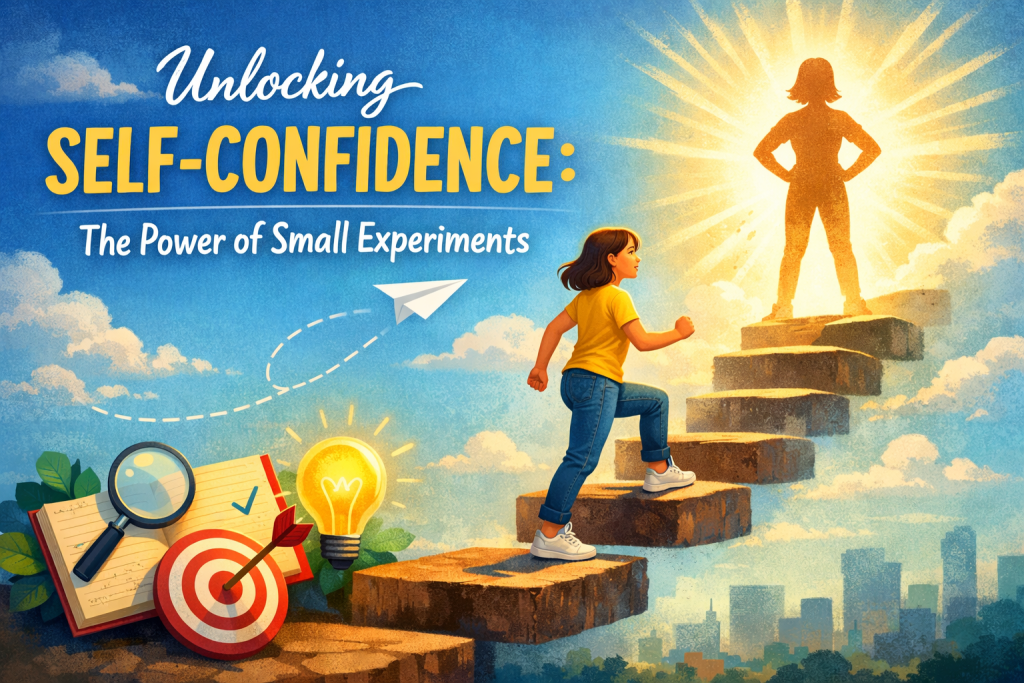
Small experiments build confidence because they turn abstract goals into concrete, low‑risk actions that produce real evidence you can use to update how you see yourself. Instead of waiting for a single dramatic breakthrough or demanding flawless performance, you design a sequence of manageable tests that expand what feels possible. Over time those tiny wins accumulate into a durable sense of capability.
Why small experiments work better than big leaps
Large goals trigger two common responses: paralysis and overcommitment. Paralysis happens when the brain treats a big change as high‑stakes and looks for reasons not to start. Overcommitment happens when you try to force a big change all at once and burn out. Small experiments avoid both traps.
- Lower emotional stakes — When the task is intentionally small, your nervous system stays calmer and you’re less likely to catastrophize failure.
- Faster feedback loops — Short experiments produce quick data: what worked, what didn’t, and what to try next.
- Reduced perfection pressure — Smallness reframes the goal as exploration rather than performance.
- Easier habit formation — Tiny, repeatable actions are more likely to stick than dramatic one‑time efforts.
Confidence grows from repeated, successful interactions with the world. Small experiments create those interactions on purpose.
Designing experiments that actually build confidence
Not every small action counts as a confidence‑building experiment. The most useful experiments are intentional, measurable, and slightly outside your comfort zone.
A simple framework to design experiments
- Define the outcome — What specific capability are you testing? (e.g., “Speak up once in a meeting.”)
- Make it small — Choose a version of the action you can complete in 5–30 minutes.
- Set a timebox — Give the experiment a clear start and end date.
- Decide what counts as success — Use a simple metric: did it happen, partially happen, or not happen?
- Plan one learning step — If it fails, what will you change next?
This structure keeps experiments practical and prevents them from becoming vague intentions.
Examples across common goals
- Social confidence — Say one short comment in a group conversation this week.
- Creative courage — Post one paragraph of writing or one sketch publicly.
- Professional growth — Ask for a 10‑minute feedback meeting with a colleague.
- Skill development — Practice a new technique for five minutes daily for a week.
Each experiment is small enough to try without dread but meaningful enough to produce useful feedback.
Reframing failure as information
A core benefit of small experiments is that they normalize failure as part of learning. When the stakes are low, setbacks stop feeling like character judgments and start feeling like data.
- Failure becomes diagnostic — Instead of “I’m bad at X,” you learn what specifically went wrong (timing, phrasing, preparation).
- You reduce shame — Small experiments make mistakes less identity‑threatening because they’re expected.
- You accelerate learning — Quick cycles of try → reflect → adjust compress the path to competence.
Treat each failed experiment as a lab result: record what happened, hypothesize why, and design the next test.
Building momentum with progressive challenge
Confidence grows most reliably when you combine frequent small wins with gradual increases in difficulty. This is the principle of progressive challenge.
- Start at the edge of comfort — Choose experiments that feel doable but slightly uncomfortable.
- Scale incrementally — After a few successes, increase the challenge by a small step (longer, public, higher stakes).
- Keep the ratio of success high — Aim for more wins than losses early on to build positive expectation.
- Celebrate micro‑wins — Acknowledge progress to reinforce the learning loop.
This approach prevents the boom‑and‑bust cycles that come from trying to leap too far too fast.
Practical habits that support experimental confidence
Experiments don’t happen in a vacuum. A few simple habits make it far easier to design, run, and learn from them.
- Schedule experiments — Put them on your calendar like appointments so they don’t get deprioritized.
- Journal briefly — One paragraph after each experiment captures what happened and what you’ll try next.
- Share accountability — Tell one trusted person about the experiment and report back.
- Limit analysis time — Spend a fixed, short amount of time reflecting so you don’t overthink.
- Rotate focus — Run experiments in different areas to avoid burnout and cross‑pollinate learning.
These habits turn experimentation from a sporadic tactic into a repeatable practice.
Using evidence to rewrite your self‑story
Confidence is a narrative you tell yourself about what you can do. Small experiments supply the evidence that lets you update that narrative.
- Collect data points — Each completed experiment is a concrete example you can point to when doubt arises.
- Create a “wins” file — Save short notes, screenshots, or messages that show progress. Review it when you feel stuck.
- Tell a new story — Replace “I’m not the kind of person who…” with “I tried X and it worked.” Evidence changes identity.
Over time, the accumulation of small successes shifts your internal script from cautious to capable.
Designing experiments for different temperaments
People respond differently to risk and novelty. Tailor experiments to your temperament so they feel motivating rather than punishing.
- For cautious planners — Use highly specific, low‑variance experiments with clear steps and contingency plans.
- For impulsive starters — Use short timeboxes and public accountability to convert energy into consistent practice.
- For perfectionists — Emphasize iteration and set “good enough” criteria to prevent endless polishing.
- For anxious doers — Pair experiments with grounding rituals (breathwork, brief walk) to reduce activation.
Matching the experiment to your style increases the chance you’ll follow through.
When experiments stall: troubleshooting common problems
Even well‑designed experiments sometimes fail to produce momentum. Common causes and fixes:
- Problem: You never start. Fix: Make the first step absurdly small (two minutes) and schedule it.
- Problem: You quit after one failure. Fix: Commit to a minimum number of trials (e.g., three attempts) before reassessing.
- Problem: You overanalyze results. Fix: Use a one‑page reflection template: what happened, why, next step. Limit reflection to 10–15 minutes.
- Problem: Experiments feel meaningless. Fix: Reconnect to the larger purpose—why this capability matters to you.
Treat stalls as part of the process, not proof you should stop.
How to scale experiments into lasting change
Small experiments are the entry point; scaling them turns temporary wins into stable confidence.
- Systematize successful experiments — Turn repeatable experiments into weekly habits.
- Bundle experiments — Combine related small actions into a single routine (e.g., five minutes of practice + one public share).
- Measure progress over months — Track frequency and outcomes to see long‑term trends.
- Teach what you learn — Explaining your process to others reinforces competence and consolidates learning.
Scaling is about turning episodic courage into a reliable way of operating.
Realistic timelines and expectations
Confidence built through experiments is durable but not instantaneous. Expect gradual change.
- Short term (weeks) — Reduced anxiety about starting, a few small wins, clearer next steps.
- Medium term (months) — Noticeable shifts in behavior, more frequent risk‑taking, improved skill.
- Long term (year+) — A revised self‑narrative and a higher baseline of confidence across contexts.
Patience matters. The compound effect of many small experiments is what creates lasting transformation.
A final, practical checklist to begin today
- Pick one area where you want more confidence.
- Design one experiment using the framework: outcome, small action, timebox, success metric.
- Schedule it on your calendar within the next 48 hours.
- Run it, journal one paragraph, and decide the next step.
- Repeat at least three times before changing strategy.
Small, consistent action beats occasional heroics.
Small experiments are not a shortcut; they are a methodical path to real capability. They reduce fear, increase evidence, and rewire your identity through lived experience rather than wishful thinking. Which small experiment could you schedule this week that would move you one meaningful step closer to the confidence you want?
- learn more in How to EQ Your Feelings
- dive deeper with The Musician’s Tech Toolbox
- explore Producer’s Guide to Avoiding Human Contact