

Navigating Boundaries Gracefully: A Guide to Building Healthy Boundaries Without Guilt
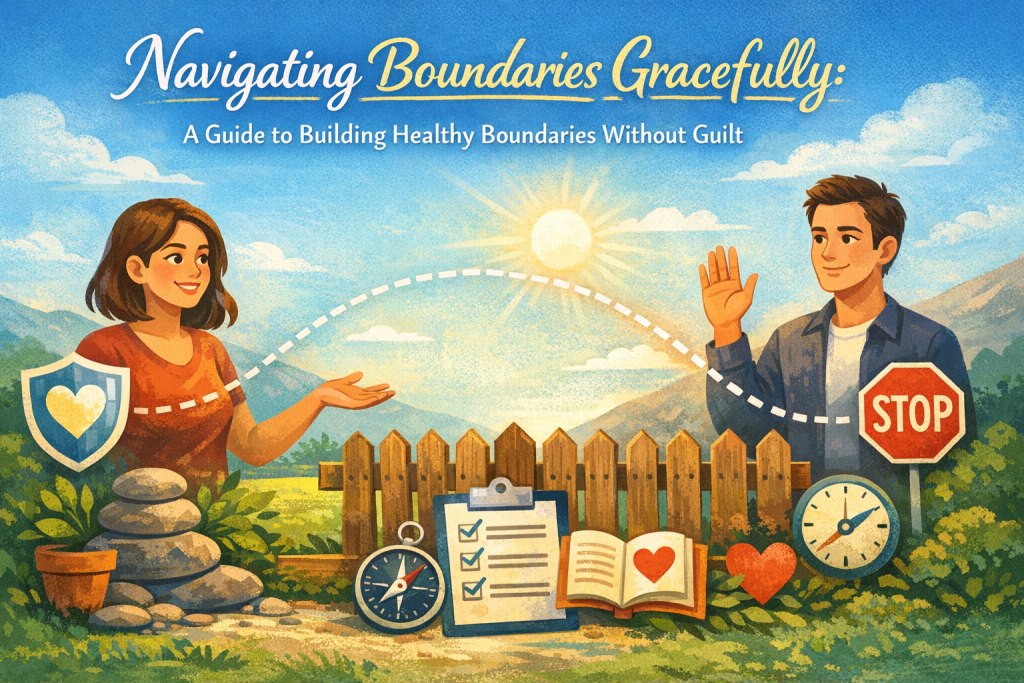
Healthy boundaries are not barriers that push people away—they are the structures that allow you to stay connected without losing yourself. When you set boundaries from a place of self‑respect rather than fear, they land as clarity instead of conflict. They help you protect your energy, communicate honestly, and build relationships that feel mutual rather than draining.
Navigating Boundaries Gracefully: A Guide to Building Healthy Boundaries Without Guilt
Most people aren’t taught how to set boundaries. Instead, they learn to be agreeable, helpful, accommodating, or endlessly available—often at the cost of their own well‑being. When you finally try to set a limit, it can feel harsh, selfish, or uncomfortable, even when the boundary is reasonable and necessary.
But boundaries are not punishments. They are not walls. They are not ultimatums. Boundaries are clarity—clear communication about what you can give, what you need, and how you want to be treated. They are a form of self‑respect that also strengthens your relationships by making expectations transparent.
Learning to set boundaries gracefully is less about mastering perfect scripts and more about shifting the story you tell yourself about what boundaries mean. When you understand the emotional roots of your discomfort and learn to communicate with steadiness, boundaries become a natural part of how you care for yourself and others.
Why Boundaries Feel Uncomfortable
If boundaries are so healthy, why do they feel so difficult? The answer lies in the beliefs and experiences many people carry into adulthood.
Wanting to be liked or seen as helpful
If you grew up believing your value comes from being agreeable, saying no can feel like a threat to your identity. You may fear that setting limits will make people see you as difficult, selfish, or unkind.
Fear of disappointing others
Many people avoid boundaries because they don’t want to let anyone down. They imagine the other person’s disappointment as something they must prevent, even at their own expense.
Past experiences where needs were dismissed
If your needs were minimized, ignored, or punished in the past, asserting them now may feel unsafe. Your nervous system may interpret boundaries as conflict, even when the situation is calm.
Internalized beliefs about worth
Some people believe—often unconsciously—that their worth is tied to being available, helpful, or self‑sacrificing. Boundaries challenge that belief, which can create guilt or anxiety.
Understanding these emotional roots doesn’t make boundaries easier overnight, but it helps you approach them with compassion rather than self‑criticism. You’re not “bad at boundaries”—you’re unlearning old patterns.
Recognizing Your Worth as the Foundation
Healthy boundaries begin with the belief that your needs matter. Without that foundation, every boundary feels like a negotiation with guilt.
When you recognize your worth, it becomes easier to:
- Say no without apologizing
- Protect your time and energy
- Choose relationships that feel reciprocal
- Let go of the pressure to overextend
- Trust that your needs are valid
This internal shift reframes boundaries from “taking something away from others” to “honoring yourself so you can show up more fully.” Boundaries become an act of care, not conflict.
A helpful mindset shift
Instead of thinking:
“If I set this boundary, I’m being selfish.”
Try:
“If I don’t set this boundary, I’m abandoning myself.”
Boundaries are not about controlling others—they’re about taking responsibility for your own well‑being.
Communicating Boundaries with Clarity and Kindness
Clear communication is what transforms a boundary from a tense moment into a grounded conversation. You don’t need long explanations or emotional justifications. You simply need clarity.
Use simple, direct language
Short, clear statements reduce confusion and prevent over‑explaining.
Examples:
- “I’m not available tonight.”
- “I can stay for an hour, but then I need to head out.”
- “I can’t take this on, but I hope you find the support you need.”
State your needs without defensiveness
You don’t need to justify your boundary with elaborate reasons. A boundary is valid because it supports your well‑being.
Keep your tone calm and neutral
Boundaries delivered with calmness feel less like confrontation and more like information.
Offer alternatives when appropriate
This is optional—not required—but sometimes helpful.
Examples:
- “I can’t meet today, but I’m free later this week.”
- “I can’t help with that project, but I can recommend someone else.”
Clarity is kind. It removes guesswork and helps others understand how to interact with you respectfully.
Practicing Self‑Compassion When Guilt Shows Up
Guilt is a normal part of boundary‑setting, especially if you’re used to prioritizing others. The goal isn’t to eliminate guilt—it’s to move through it without abandoning yourself.
Acknowledge the discomfort
Guilt is a sign that you’re doing something new, not something wrong.
Remind yourself that caring for your needs is healthy
You cannot pour from an empty cup. Boundaries protect your capacity to give.
Recognize that boundaries strengthen relationships
Healthy relationships thrive on honesty, not self‑sacrifice.
Let your nervous system adjust
Over time, as you set more boundaries and see that the world doesn’t collapse, the guilt fades. Your body learns that boundaries are safe.
Self‑compassion is the antidote to guilt. Treat yourself with the same understanding you would offer a friend.
Staying Consistent to Reinforce Your Boundaries
Consistency teaches others how to treat you. When you hold your boundaries firmly, you create predictability and trust.
Consistency helps you:
- Build trust with yourself
- Reduce resentment and burnout
- Create healthier relationship dynamics
- Communicate your needs without mixed signals
Inconsistency—saying no one day and yes the next—confuses people and makes boundaries harder to maintain. Even small, steady steps make a big difference.
A helpful reminder
A boundary is only as strong as your willingness to uphold it.
Listening to Your Emotional Cues
Your emotions are early warning signs. They tell you when something is off long before your mind catches up.
Common emotional cues that signal a boundary is needed:
- Resentment
- Irritation
- Exhaustion
- Feeling taken for granted
- Dreading interactions
- Feeling overwhelmed or overextended
These emotions are not flaws—they are information. They help you identify where limits are missing or where an existing boundary has been crossed.
Listening to your cues helps you:
- Adjust boundaries before burnout hits
- Communicate needs earlier and more calmly
- Stay connected to your values and well‑being
Your body often knows before your mind does. Paying attention to these signals is an act of self‑respect.
Seeking Support as You Strengthen Your Boundaries
Boundaries can feel vulnerable, especially if you’re new to them. Support from others can help you stay grounded and confident.
Support can come from:
- Friends or family who listen without judgment
- Communities or groups that understand your experience
- Mentors who model healthy boundaries
- Therapists or counselors who help you navigate emotional patterns
Support helps you validate your experiences, practice language for difficult conversations, and stay steady when others push back.
You don’t have to build boundaries alone.
How to Navigate Pushback Gracefully
Not everyone will welcome your boundaries—especially if they benefited from your lack of them. Pushback is not a sign that your boundary is wrong; it’s a sign that it’s working.
Common forms of pushback:
- Guilt‑tripping
- Minimizing your needs
- Acting confused
- Testing your limits
- Becoming distant or irritated
How to respond gracefully:
- Stay calm and repeat your boundary
- Avoid over‑explaining
- Don’t apologize for your needs
- Remember that their reaction is about them, not you
Healthy people respect boundaries. Unhealthy reactions reveal where the relationship may need adjustment.
Integrating Boundaries into Daily Life
Boundaries become easier when they’re woven into your everyday habits rather than reserved for crises.
Daily practices that support healthy boundaries:
- Checking in with your energy levels
- Saying no to small things to build confidence
- Pausing before agreeing to new commitments
- Creating routines that protect your time
- Practicing honest communication in low‑stakes situations
These small habits build the muscle of boundary‑setting, making it easier to navigate bigger moments with clarity.
The Long‑Term Impact of Healthy Boundaries
When you set boundaries consistently and compassionately, your life begins to shift in meaningful ways.
You experience:
- More emotional steadiness
- Less resentment
- More fulfilling relationships
- Greater self‑trust
- Increased energy and focus
- A deeper sense of agency
Boundaries create space for the life you actually want—not the life you feel obligated to maintain.
Setting boundaries is an act of self‑respect, not selfishness. When you honor your needs, you create healthier relationships, clearer communication, and a more sustainable life. As you reflect on your own patterns, where do you feel the most tension right now—saying no, communicating clearly, staying consistent, or managing guilt afterward?
- grab your copy of Why People Ghost You
- check out I’m Married, Now What?
- dive deeper with How to Train Your Human