

Unlocking Creativity: Generating Endless Ideas Through Modular Thinking
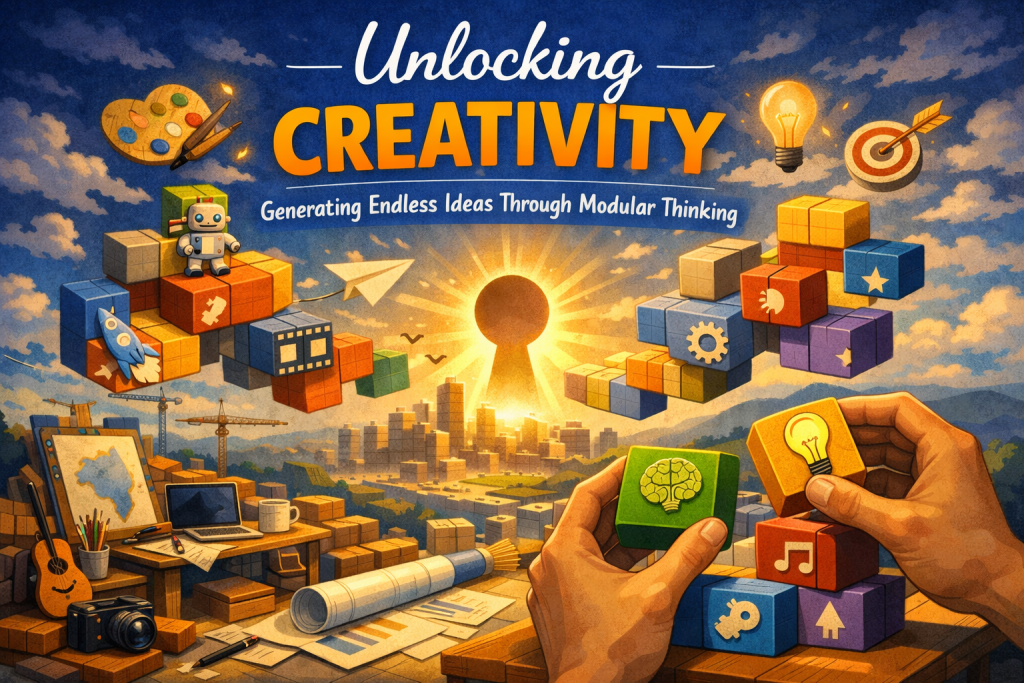
Unlocking Creativity: Generating Endless Ideas Through Modular Thinking
In a fast‑paced creative world, the ability to consistently produce fresh ideas is a powerful advantage. Writers, designers, entrepreneurs, educators, and creators of all kinds rely on a steady flow of inspiration to stay relevant, innovative, and fulfilled. But inspiration doesn’t always arrive on demand. Some days, ideas feel abundant; other days, the well seems dry.
This is where modular thinking becomes a game‑changer.
Modular thinking offers a flexible, repeatable way to generate ideas without burning out. Instead of waiting for lightning to strike, you learn to break concepts into smaller parts—modules—that can be examined, rearranged, and recombined in countless ways. The result is a creative system that produces ideas reliably, sustainably, and often surprisingly.
This article explores what modular thinking is, why it works, and how you can use it to unlock endless creative possibilities.
What Modular Thinking Is
Modular thinking involves breaking a complex problem, project, or concept into smaller, manageable parts. Each part becomes a “module” you can explore independently and then recombine in new ways.
This approach:
- Makes big challenges feel less overwhelming
- Helps you see new angles and possibilities
- Encourages experimentation and unconventional thinking
- Reduces pressure by giving you smaller, easier starting points
- Creates a library of reusable components you can draw from anytime
When you work with smaller units, you unlock more combinations—and more ideas. Instead of trying to invent something from scratch, you remix what you already have.
Everyday Examples of Modular Thinking
You already use modular thinking more often than you realize:
- Cooking: Ingredients are modules. You combine them differently to create new dishes.
- Music: Notes, chords, and rhythms are modules. Rearranging them creates new songs.
- Writing: Scenes, characters, themes, and structures are modules. Reordering them changes the story.
- Design: Colors, shapes, textures, and layouts are modules. Mixing them creates new aesthetics.
Modular thinking simply makes this natural process intentional and repeatable.
Why Modular Thinking Works
Modular thinking is powerful because it aligns with how the brain naturally processes information. Instead of forcing yourself to create something entirely new, you work with familiar pieces in unfamiliar ways.
It Activates Divergent Thinking
Divergent thinking is the ability to generate multiple ideas from a single starting point. Your brain naturally makes associations, and modular thinking amplifies this by giving you more pieces to connect.
The more modules you have, the more combinations you can create.
It Supports Rapid Iteration
Because you’re working with modular units, you can quickly test new combinations without starting from scratch. This speeds up experimentation and discovery.
You can:
- Swap one module for another
- Rearrange the order
- Combine modules from different projects
- Add or remove elements to shift direction
Iteration becomes playful instead of stressful.
It Builds Creative Flexibility
As you practice breaking ideas into modules, you develop a more adaptable mindset. You become better at:
- Pivoting when something isn’t working
- Reframing challenges
- Seeing hidden connections
- Generating unconventional solutions
Modular thinking trains your brain to think in possibilities rather than limitations.
How to Start Using Modular Thinking
Modular thinking is simple to learn and easy to apply. You can use it for brainstorming, problem‑solving, planning, storytelling, product development, and more.
Here’s how to begin.
Identify the Core Components
Start by defining the main elements of your project or problem. Break them down into smaller modules so you can understand each part clearly and independently.
For example, if you’re writing a story, your modules might include:
- Characters
- Setting
- Conflict
- Themes
- Scenes
- Emotional beats
If you’re designing a product, your modules might include:
- Features
- User needs
- Materials
- Aesthetic elements
- Functions
The goal is to create a list of building blocks.
Explore Each Module
Once you’ve identified your modules, examine them individually.
Ask questions like:
- What purpose does this module serve?
- What happens if I change it?
- What are alternative versions of this module?
- How does it interact with other modules?
This deep understanding gives you more creative control. You’re no longer dealing with a vague, overwhelming whole—you’re working with clear, manageable parts.
Recombine the Parts
This is where the magic happens.
Mix and match modules in different ways. Try alternative connections, swap elements, or shift the order. Even small changes can spark entirely new ideas.
For example:
- Change the setting of a story and the entire plot shifts.
- Swap a feature in a product and you unlock a new market.
- Rearrange steps in a process and you discover a more efficient workflow.
- Combine two unrelated modules and you create something original.
Recombination is the engine of innovation.
Practical Ways to Apply Modular Thinking
Modular thinking is versatile. You can use it in almost any creative or professional context.
Here are some practical applications.
Brainstorming New Ideas
Instead of staring at a blank page, start with modules. Write down:
- Themes
- Problems
- Emotions
- Characters
- Tools
- Constraints
- Formats
Then start combining them. You’ll generate dozens of ideas quickly.
Solving Creative Blocks
When you’re stuck, break the problem into modules and focus on just one. Often, solving one small piece unlocks the whole.
Developing Long‑Term Projects
Modular thinking helps you:
- Outline books
- Plan courses
- Build product lines
- Create content series
- Design multi‑phase projects
Each module becomes a milestone.
Repurposing Existing Work
One of the biggest advantages of modular thinking is that it helps you reuse what you’ve already created.
A single module—like a concept, paragraph, sketch, or idea—can be:
- Expanded
- Reframed
- Combined with something new
- Turned into a different format
This saves time and multiplies your output.
The Creative Benefits of Modular Thinking
Modular thinking transforms creativity from something mysterious into something you can reliably cultivate.
It helps you:
- Overcome creative blocks
- Spark inspiration on demand
- Generate unconventional ideas
- Stay agile in your creative process
- Push beyond predictable solutions
- Reduce overwhelm
- Build confidence in your ability to create
Instead of waiting for inspiration, you create the conditions where inspiration thrives.
Unlocking Your Creative Potential
By breaking down complex problems into smaller parts and recombining them in new ways, modular thinking becomes a powerful tool for generating endless ideas. It helps you stay ahead of the curve, stand out in a crowded market, and expand the boundaries of your imagination.
Creativity becomes less about pressure and more about play. Less about perfection and more about exploration. Less about waiting and more about building.
As you continue refining this approach, which creative area are you most excited to apply modular thinking to next?
Further Reading:
Resources to help you go deeper
- learn more in How to EQ Your Feelings
- dive deeper with The Musician’s Tech Toolbox
- explore Producer’s Guide to Avoiding Human Contact