

The Creative Power of Embracing Stillness
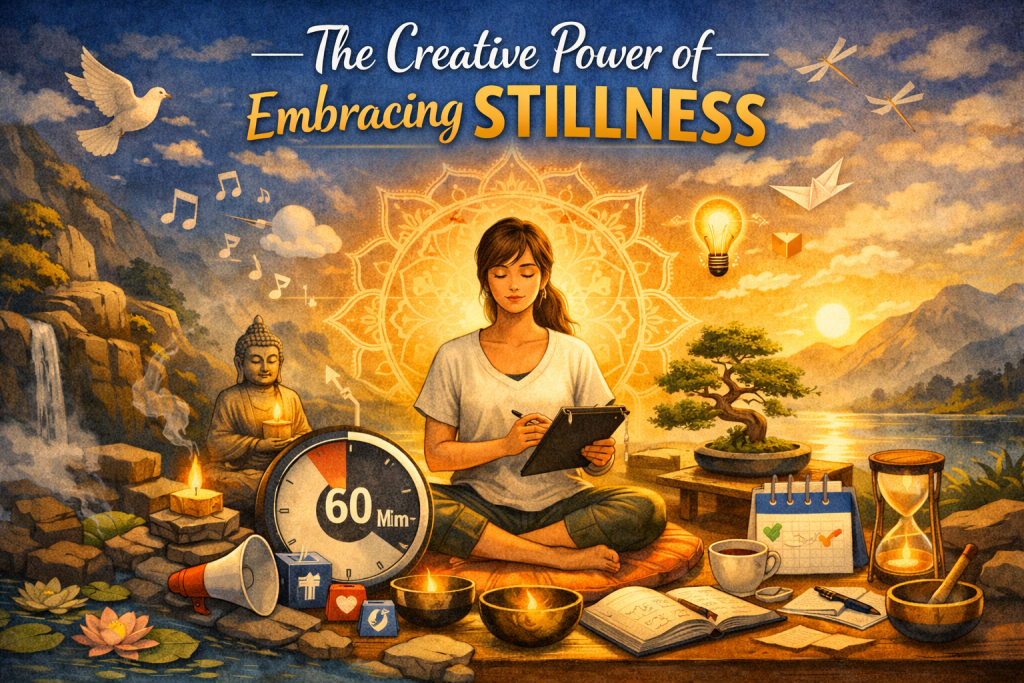
The creative power of stillness becomes much clearer when you expand it into a full, flowing article that treats “doing nothing” not as laziness, but as a deliberate creative strategy.
The Creative Power of Embracing Stillness
Why Doing Nothing Is One of the Most Productive Things You Can Do
In a world that rewards constant motion, the idea of doing nothing can feel uncomfortable, indulgent, or even irresponsible. We’re conditioned to equate productivity with visible effort—typing, planning, producing, pushing. Yet some of the most profound creative breakthroughs don’t happen when we’re grinding. They happen in the quiet spaces between tasks, in the pauses we rarely allow ourselves, in the moments when we stop trying so hard.
Stillness has a quiet power that many people overlook. Allowing your mind to rest and wander freely can unlock creativity in ways that focused effort often cannot. When you intentionally slow down, you create the mental spaciousness where ideas can breathe, connect, and evolve.
This is the paradox of creativity: sometimes the most productive thing you can do is nothing at all.
Why Stillness Enhances Creativity
Creativity isn’t just about generating ideas—it’s about making connections. And those connections often form when the mind is relaxed rather than intensely focused. Research in cognitive science shows that stepping away from constant stimulation supports both creativity and problem‑solving. When you pause and give your mind space, several things happen:
- Your brain shifts into a more relaxed, associative mode.
- You begin making connections you wouldn’t see while concentrating intensely.
- New ideas surface from your subconscious, where much of your creative processing happens.
This gentle mental drift is not wasted time—it’s fertile ground for insight. When you stop forcing solutions, your mind begins to offer them freely.
The Science Behind the Pause
When you’re resting, your brain activates what’s known as the default mode network—a system associated with imagination, memory, and internal reflection. This network lights up during:
- Daydreaming
- Mind‑wandering
- Quiet reflection
- Gentle, repetitive tasks like walking or showering
These states allow your brain to integrate information, form new associations, and generate original ideas. In other words, stillness is not the absence of creativity—it’s the incubator for it.
The Role of Mind‑Wandering in Idea Generation
Mind‑wandering is often misunderstood as distraction or lack of discipline. But in creative work, it’s a powerful tool. Periods of idleness allow your thoughts to meander without direction or pressure. This wandering:
- Encourages fresh perspectives
- Helps you break out of rigid thinking patterns
- Supports innovative leaps that structured work can’t always produce
Many artists, thinkers, and innovators throughout history have credited their breakthroughs to moments of rest, daydreaming, or quiet reflection. Einstein famously relied on “thought experiments” that emerged during idle moments. Virginia Woolf took long, aimless walks to unlock narrative insights. Steve Jobs was known for his walking meetings, which sparked clarity and creativity.
Mind‑wandering is not a distraction from creativity—it is creativity in motion.
Why “Doing Nothing” Is Part of the Creative Process
Creativity requires both input and integration. You gather ideas, experiences, and information—but you also need time for your mind to process them. Stepping away from your usual tasks gives your brain a chance to reset. When you stop forcing solutions, your subconscious continues working in the background. This is often when clarity emerges.
Moments of stillness can:
- Unblock stalled ideas
- Spark unexpected inspiration
- Reveal solutions that weren’t visible before
- Restore emotional and mental energy
- Reconnect you with your intuition
Doing nothing becomes a strategic pause rather than a distraction. It’s the creative equivalent of letting dough rise—nothing appears to be happening, but transformation is underway.
Making Space for Stillness
Stillness doesn’t require a retreat, a meditation cushion, or hours of free time. It can be woven into your daily routine in simple, accessible ways. When you feel stuck or uninspired, consider intentionally slowing down. Let yourself:
- Daydream
- Sit quietly
- Take a walk without a goal
- Stare out the window
- Follow your thoughts wherever they go
- Step away from screens
- Breathe deeply for a few minutes
These simple acts create the mental spaciousness creativity needs to flourish. They also help you reconnect with your inner world—the place where your most original ideas live.
Micro‑Moments of Stillness
Even 30 seconds of intentional pause can shift your mental state. Try:
- Closing your eyes between tasks
- Taking three slow breaths before starting a project
- Looking at the sky for a moment
- Letting your mind drift during a break
Stillness doesn’t have to be long to be effective. It just has to be intentional.
A Different Kind of Productivity
We often think of productivity as output—how much we produce, how quickly we move, how efficiently we work. But creative productivity is different. It’s not measured by speed or volume. It’s measured by clarity, originality, and depth.
Embracing stillness isn’t about stepping away from your work—it’s about stepping toward deeper creativity. When you allow yourself to do nothing, you open the door to ideas that can’t emerge under pressure.
Stillness helps you:
- Think more clearly
- Create more intentionally
- Work with greater focus
- Avoid burnout
- Stay connected to your creative purpose
It’s not a break from creativity—it’s part of the creative cycle.
Integrating Stillness Into Your Creative Routine
To make stillness a sustainable part of your creative life, treat it as a practice rather than an escape. You can integrate it by:
- Scheduling short pauses between tasks
- Taking a daily walk without headphones
- Starting your creative sessions with a moment of quiet
- Ending your day with reflection instead of stimulation
- Allowing yourself “white space” in your calendar
Stillness becomes easier when you give it a place in your routine.
The Courage to Slow Down
In a culture obsessed with speed, slowing down takes courage. Doing nothing requires trust—trust that your creativity doesn’t disappear when you stop working, trust that your mind knows how to generate ideas without constant pressure, trust that rest is not a weakness but a strength.
Stillness is not the opposite of ambition. It’s the foundation of sustainable creativity.
When you embrace it, you give yourself permission to create from a place of clarity rather than urgency, depth rather than exhaustion, intuition rather than fear.
Which part of your creative routine feels most ready for a little intentional stillness right now?
- learn more in How to EQ Your Feelings
- dive deeper with The Musician’s Tech Toolbox
- explore Producer’s Guide to Avoiding Human Contact