

Unraveling the Mystery: The Science Behind Motivation and Its Role in Starting and Stopping
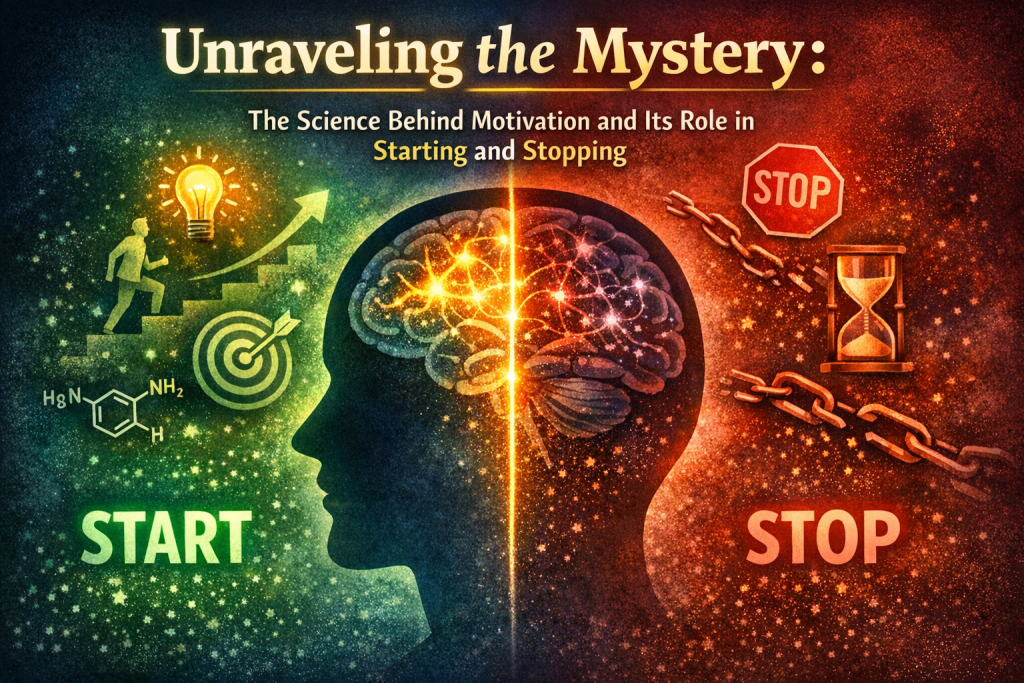
Unraveling the Mystery: The Science Behind Motivation and Its Role in Starting and Stopping
Why motivation starts, stops, and fluctuates?
Motivation isn’t a personality trait or a moral failing — it’s a biological and psychological cycle that naturally rises and falls. When it disappears, it’s not because you’re lazy or broken; it’s because your brain is responding to stress, uncertainty, habits, and energy in predictable ways. Understanding the science behind motivation helps you stop blaming yourself and start working with your brain instead of fighting it. This guide breaks down why motivation surges, stalls, and sometimes vanishes, and shows you how to use that knowledge to create sustainable momentum in your daily life.
Motivation often feels like weather — sometimes bright and energizing, sometimes foggy and unpredictable, sometimes completely gone without warning. People talk about it as if it’s a personality trait (“I’m just not a motivated person”) or a moral quality (“If I cared enough, I’d do it”). But motivation isn’t magic, and it isn’t a character flaw. It’s a biological, emotional, and psychological cycle that every human experiences.
When you understand how motivation actually works — what fuels it, what drains it, and why it fluctuates — you stop blaming yourself and start designing habits, environments, and expectations that work with your brain instead of against it.
This guide gently walks you through the science behind motivation, why it surges and stalls, and how to use that knowledge to create sustainable momentum in your life.
Let’s make motivation feel less mysterious and more manageable.
1. What Motivation Actually Is (In Plain, Human Language)
Motivation is the internal process that influences whether you:
- start something
- keep going
- or stop altogether
It’s not a fixed trait. It’s not “who you are.” It’s a cycle — one that naturally rises and falls.
Two main forces shape your motivation:
Intrinsic motivation
Doing something because it feels meaningful, enjoyable, or aligned with who you are. This type is durable because it’s tied to identity and satisfaction.
Examples:
- writing because it helps you express yourself
- exercising because it makes you feel strong
- learning because you’re curious
Extrinsic motivation
Doing something for an external reward or to avoid a negative outcome.
Examples:
- deadlines
- grades
- praise
- money
- fear of consequences
Extrinsic motivation can be powerful, but it often fades unless it’s supported by something internal.
Most goals require both.
The key is understanding which one is driving you — and whether it’s sustainable.
2. How the Brain Fuels Motivation (The Gentle Neuroscience Version)
Motivation is deeply connected to the brain’s reward system. Several neurotransmitters work together to shape your drive, focus, and persistence.
Dopamine — the “anticipation and progress” chemical
Dopamine spikes when you experience progress, novelty, or small wins. It reinforces behaviors that lead to positive outcomes.
This is why:
- checking off a tiny task feels good
- breaking goals into small steps works
- momentum builds motivation
Dopamine isn’t about pleasure — it’s about movement toward something.
Serotonin — the “mood stability” chemical
Balanced serotonin helps you feel grounded, steady, and emotionally regulated. When serotonin dips, overwhelm rises — and motivation drops.
Norepinephrine — the “focus and alertness” chemical
This helps you stay engaged, especially during challenging tasks. It supports attention, energy, and mental clarity.
These chemicals don’t work alone.
They interact with:
- your environment
- your stress levels
- your beliefs
- your past experiences
- your emotional state
This is why motivation feels different from day to day — even when your goals stay the same.
Beginner reassurance
If your motivation fluctuates, nothing is wrong with you. Your brain is responding to real conditions.
3. Why Motivation Fluctuates (And Why That’s Normal)
Motivation isn’t just brain chemistry. It’s shaped by a mix of internal and external factors that shift over time.
Personality traits
Some people naturally seek novelty or challenge. Others thrive on routine and predictability.
Both are valid.
Past experiences
Success builds confidence. Repeated failure can create avoidance or fear.
Your brain remembers what felt safe — and what didn’t.
Social influences
Encouragement, expectations, comparison, and community all affect your drive.
Emotional state
Stress, burnout, fear, uncertainty, or grief can suppress motivation even when the goal still matters.
Environment
Clutter, noise, lighting, temperature, and accessibility all influence your willingness to start.
Energy levels
Sleep, nutrition, hormones, and physical health all play a role.
Beginner reassurance
Motivation isn’t a moral issue. It’s a system responding to your context.
4. How to Start Strong (Without Relying on Willpower)
The beginning of a goal is often the hardest part. Your brain loves clarity, simplicity, and quick wins.
Set specific, achievable goals
Vague goals create anxiety. Clear goals create direction.
Instead of: “Get healthier” Try: “Walk for 10 minutes after lunch.”
Break big goals into tiny steps
Small steps reduce overwhelm and increase dopamine rewards.
Instead of: “Write a book” Try: “Write for 5 minutes.”
Track your progress
Your brain loves evidence of success. A simple checklist or habit tracker can reinforce momentum.
Connect your goal to meaning
Ask: “Why does this matter to me?” Meaning strengthens intrinsic motivation.
Beginner reassurance
Starting strong isn’t about intensity — it’s about clarity and momentum.
5. How to Stay Motivated When It Fades (Because It Will)
Motivation naturally dips. This isn’t a failure — it’s part of the cycle.
What matters is how you respond when the initial excitement wears off.
Reassess your goals
Do they still align with your values? Sometimes motivation fades because the goal no longer fits.
Seek support
Friends, mentors, peers, or communities can offer perspective and encouragement.
Practice self‑compassion
Shame shuts down motivation. Kindness reopens the door.
Try saying: “I’m struggling, but I’m still trying.” “I can start again.” “This dip is temporary.”
Focus on progress, not perfection
Perfectionism kills momentum. Progress builds it.
Beginner reassurance
A dip in motivation is a signal, not a stop sign.
6. Using the Science of Motivation to Your Advantage
Once you understand why you start and why you stop, you can design habits and environments that support your goals.
Reduce friction
Make the first step as easy as possible.
- Lay out your clothes the night before
- Keep your guitar on a stand instead of in a case
- Open your writing document before bed
Create supportive environments
Your surroundings should help you start, not hinder you.
Use small wins to reinforce momentum
Celebrate tiny progress. Your brain responds to it.
Align goals with your values
When something matters to you, motivation becomes more durable.
Beginner reassurance
Motivation becomes something you cultivate, not something you wait for.
Final Reflection: What Part of Motivation Matters Most to You Right Now?
As you think about your current goals, consider which part of the motivation cycle feels most relevant:
- the neuroscience (how your brain fuels motivation)
- the emotional factors (how stress, fear, or overwhelm affect your drive)
- the strategies (how to start, sustain, and restart momentum)
Each one offers a different doorway into understanding yourself more deeply.
Further Reading:
Resources to help you go deeper
- learn more in How to EQ Your Feelings
- dive deeper with The Musician’s Tech Toolbox
- explore Producer’s Guide to Avoiding Human Contact