

5 Tips to Stop Taking Everything Personally
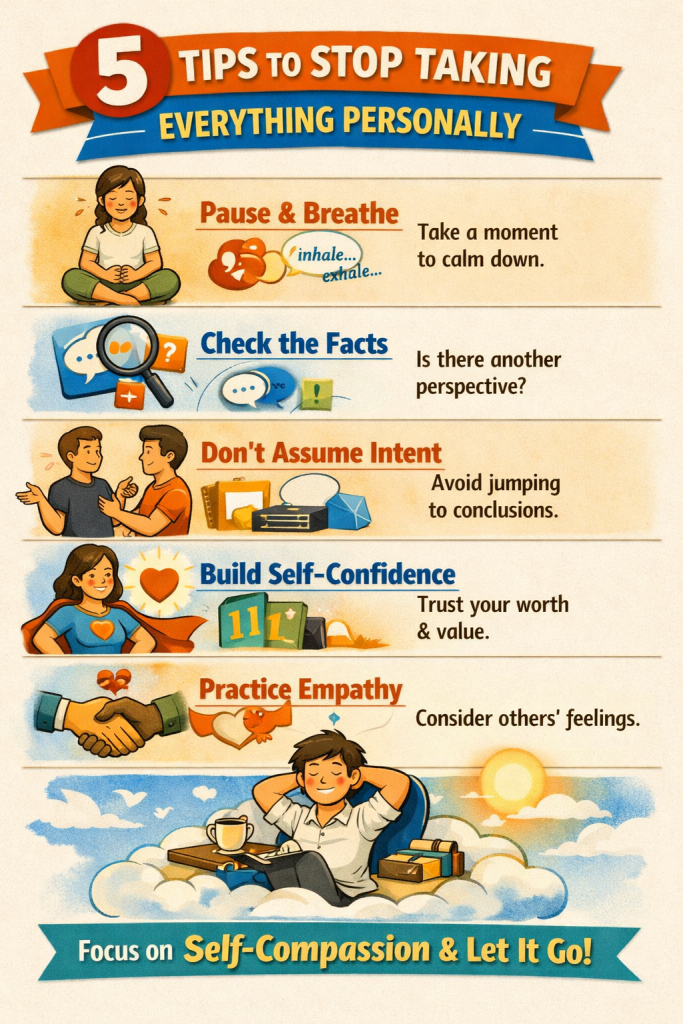
Taking things personally is one of the most common—and most exhausting—emotional habits people struggle with. It drains confidence, distorts communication, and turns neutral moments into sources of stress. But it’s also a habit you can unlearn. When you understand the psychology behind why it happens and adopt practical tools to interrupt the pattern, you create more emotional freedom, clarity, and resilience in your daily life.
5 Tips to Stop Taking Everything Personally
How to Break the Habit of Internalizing What Isn’t Yours
Taking everything personally can feel like walking through the world without emotional armor. A comment, a tone shift, a delayed text, a piece of feedback—any of it can trigger spirals of self‑doubt or defensiveness. Over time, this habit becomes draining and can quietly erode confidence, relationships, and peace of mind.
The good news is that taking things personally is not a fixed trait. It’s a learned pattern rooted in emotional sensitivity, past experiences, and protective instincts—and like any pattern, it can be reshaped. With awareness and practice, you can build a healthier mindset that allows you to respond rather than react, interpret rather than assume, and stay grounded even when situations feel charged.
Understanding Why We Take Things Personally
Before shifting the habit, it helps to understand why it forms in the first place. People tend to take things personally when:
- They’ve experienced criticism or rejection in the past
- Their self‑esteem feels fragile or conditional
- They’re highly empathetic and attuned to others’ emotions
- They fear conflict or disapproval
- They interpret ambiguity as danger
In other words, taking things personally is often a form of emotional self‑protection. The mind tries to make sense of discomfort by assuming the threat is about you. But this instinct, while understandable, often misfires.
Breaking the habit begins with recognizing that most people’s behavior reflects their own inner world—not yours.
1. Practice Self‑Awareness
Self‑awareness is the first and most powerful step. When you feel that familiar sting—tightness in the chest, a rush of defensiveness, a sudden drop in mood—pause and observe what’s happening internally.
Ask yourself:
- What story am I telling myself right now?
- Is this reaction based on the present moment or something older?
- What insecurity is being activated?
This pause interrupts the automatic reaction and gives you space to choose a different response. It also helps you see that the emotional intensity often comes from your interpretation, not the situation itself.
Self‑awareness doesn’t eliminate sensitivity—it transforms it into insight.
2. Separate Facts From Interpretation
When someone says or does something that feels negative, your mind instantly fills in the blanks. But the story you create is often far more painful than the reality.
Separating facts from interpretation helps you stay grounded.
- Fact: “They didn’t respond to my message.”
- Interpretation: “They’re annoyed with me.”
- Fact: “They gave me feedback.”
- Interpretation: “They think I’m incompetent.”
- Fact: “Their tone was short.”
- Interpretation: “I must have done something wrong.”
Facts are neutral. Interpretations are emotional. When you learn to distinguish the two, you reduce unnecessary suffering and open the door to more accurate understanding.
3. Communicate Openly Instead of Assuming
Assumptions are the fuel of taking things personally. When you assume someone’s intention, you fill in the gaps with your fears rather than the truth.
Open communication breaks that cycle.
Try asking:
- “I noticed your tone seemed tense—are you okay?”
- “I want to make sure I understood you correctly. Did you mean…?”
- “Is there something I should be aware of?”
Most of the time, you’ll discover the issue had nothing to do with you. And even when it is about you, clarity is far less painful than uncertainty.
Open communication builds trust, reduces misinterpretation, and strengthens relationships.
4. Build Self‑Confidence From the Inside Out
The more solid your sense of self, the less power external opinions have over you. When your self‑worth is fragile, every comment feels like a verdict. When your self‑worth is grounded, feedback becomes information—not identity.
Ways to strengthen confidence include:
- Acknowledging your strengths and accomplishments
- Practicing self‑validation rather than seeking external approval
- Setting boundaries that protect your emotional energy
- Engaging in activities that reinforce competence and joy
Confidence doesn’t mean you never feel hurt. It means you don’t collapse under the weight of someone else’s mood, opinion, or misunderstanding.
5. Practice Empathy and Perspective‑Taking
One of the most liberating realizations is that people’s behavior is almost always about them—their stress, their insecurities, their distractions, their history—not about you.
Empathy helps you step outside your own emotional lens and consider alternative explanations:
- “They might be overwhelmed.”
- “They may not have realized how that came across.”
- “They could be dealing with something I don’t know about.”
This doesn’t excuse harmful behavior, but it prevents you from internalizing it. Empathy creates emotional distance, which allows you to respond with clarity rather than reactivity.
Integrating These Practices Into Daily Life
Breaking the habit of taking things personally is a gradual process. It requires patience, repetition, and compassion for yourself. Over time, these practices help you:
- Stay grounded in your own worth
- Interpret situations more accurately
- Reduce emotional reactivity
- Strengthen communication and relationships
- Move through the world with more ease and confidence
You don’t have to stop caring—you just have to stop assuming that everything is about you.
As you reflect on your own patterns, which of these five shifts feels like it would make the biggest difference for you right now?
- grab your copy of Why People Ghost You
- check out I’m Married, Now What?
- dive deeper with How to Train Your Human