
Can I Become a Music Producer if I Can’t Play an Instrument?
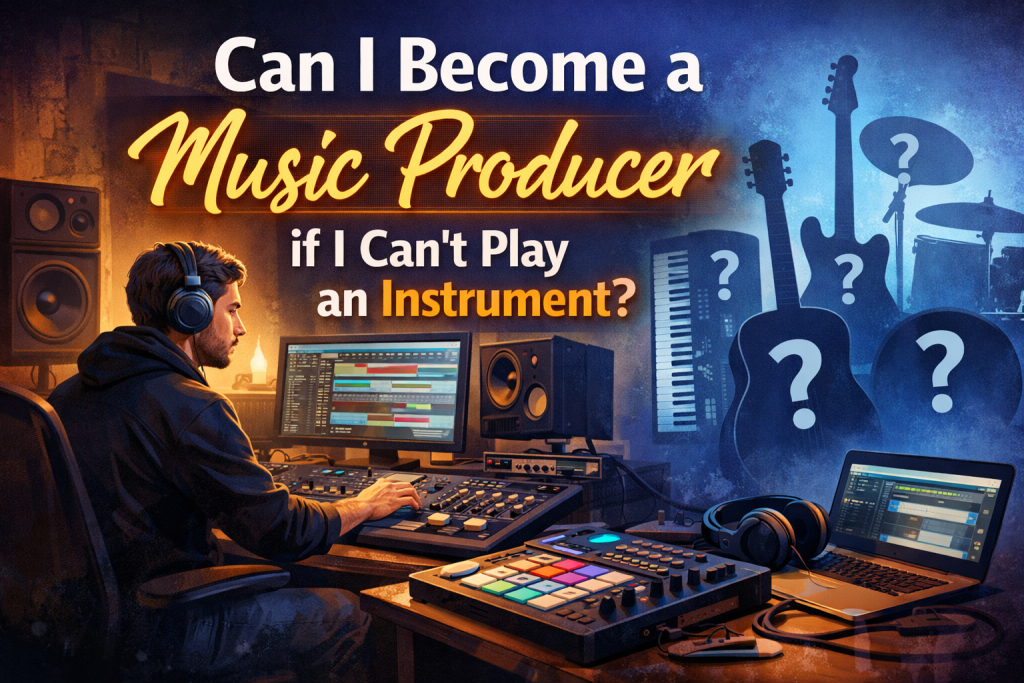
Can I Become a Music Producer if I Can’t Play an Instrument?
One of the most common questions new producers ask is: “Can I become a music producer if I can’t play an instrument?”
The short answer is absolutely yes. In fact, many successful producers built their careers without traditional instrumental skills. Modern music production is driven by creativity, technology, and sound design — not just classical musicianship.
Here’s how you can thrive as a producer even if you’ve never touched a guitar or piano.
1. Leverage Digital Tools and Software
Today’s music production landscape is built around digital tools that make it possible to create full songs without playing a physical instrument.
Digital Audio Workstations (DAWs)
DAWs like FL Studio, Ableton Live, and Logic Pro come loaded with:
- Virtual instruments
- Drum machines
- Loops and samples
- MIDI editing tools
You can compose entire tracks by clicking notes into a piano roll or arranging loops — no instrumental performance required.
MIDI Controllers
Even if you can’t play piano, MIDI controllers make music creation intuitive:
- Trigger drums with pads
- Play chords with one‑touch chord modes
- Use arpeggiators to generate melodic patterns
They turn musical ideas into sound instantly.
Sample Libraries
From drum loops to orchestral strings, sample libraries let you build professional‑sounding tracks without recording a single instrument.
2. Focus on Learning Music Theory
You don’t need to play an instrument to understand music.
Learning the basics of music theory helps you:
- Build chord progressions
- Create melodies
- Understand rhythm
- Arrange songs more effectively
There are countless beginner‑friendly resources online, and even a little theory goes a long way in improving your productions.
3. Collaborate with Musicians
Music production is a collaborative art form. If you don’t play instruments, you can still work with people who do.
Why Collaboration Helps
- You focus on production, mixing, and arrangement
- They contribute instrumental performances
- You learn from each other’s strengths
Many legendary producers rarely played instruments themselves — they directed, shaped, and elevated the music.
4. Experiment with Sound Design
Sound design is one of the most exciting parts of modern production — and it doesn’t require instrumental skills.
Using synths and plugins, you can:
- Create custom sounds
- Shape textures
- Build unique sonic identities
- Manipulate waveforms and effects
Sound design is a playground for creativity, and it’s one of the best ways to develop your signature style.
5. Learn from Successful Producers Who Don’t Play Instruments
Many influential producers built their careers through experimentation, technology, and creativity rather than instrumental performance.
They mastered:
- DAWs
- Sampling
- Sound design
- Arrangement
- Mixing
Their success proves that musicianship takes many forms — and traditional instrumental skill is only one of them.
6. Practice, Practice, Practice
Music production is a skill like any other — the more you practice, the better you get.
What to Practice
- Building beats
- Arranging songs
- Mixing and mastering
- Designing sounds
- Experimenting with genres
Over time, your ear sharpens, your workflow improves, and your creativity expands.
7. Embrace Your Unique Perspective
Not playing an instrument can actually be an advantage.
It frees you from:
- Traditional rules
- Conventional structures
- Habitual patterns
You may approach music with fresh ideas, unexpected choices, and innovative techniques — the very things that make your sound stand out.
Conclusion
You don’t need to be a skilled instrumentalist to become a successful music producer. With today’s digital tools, a willingness to learn, and a creative mindset, you can craft professional‑quality music that resonates with listeners.
Music production is about shaping sound, telling stories, and creating emotion — and there are countless ways to do that.
Your creativity matters more than your instrumental ability. Your curiosity matters more than your training. Your voice matters more than your limitations.
If you have the passion, you can produce music. And if you keep going, you can become great at it.
So, embrace the possibilities, and start producing the music you’ve always dreamed of making!