

Embracing Imperfection: Cultivating Creative Productivity for Flawed Humans
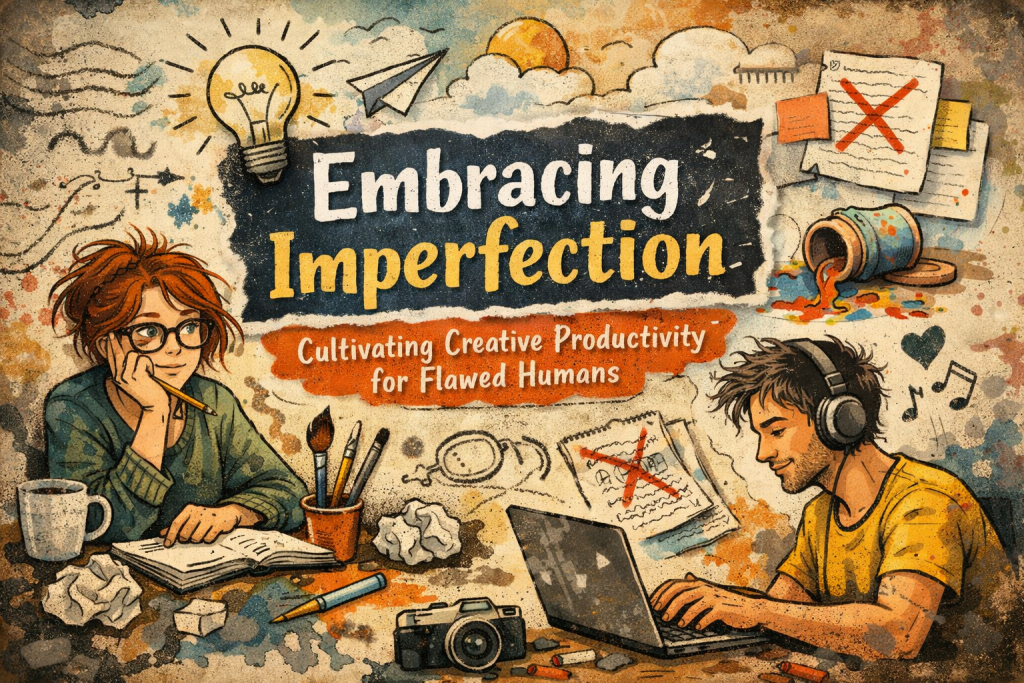
Imperfection is the heartbeat of creative work. It’s the force that keeps ideas moving, the spark that keeps experiments alive, and the quiet permission slip that allows you to begin before you feel ready. When you look closely at how meaningful creative work actually happens—in studios, notebooks, rehearsal rooms, drafting documents, and messy middle stages—you see a pattern: nothing great begins perfect. Everything great begins in motion.
Why Imperfection Is the Engine of Creative Work
Creative work is inherently exploratory. You’re navigating the unknown, making decisions without guarantees, and shaping something that didn’t exist before. That process requires flexibility, curiosity, and resilience—qualities that perfectionism actively suppresses.
Imperfection drives creativity because it:
- Removes the pressure to get everything right on the first try
- Creates psychological space for experimentation
- Encourages volume, which leads to refinement
- Allows ideas to evolve rather than freeze
- Keeps you moving instead of stuck in hesitation
Perfectionism narrows your options. Imperfection expands them. When you allow yourself to be imperfect, you open the door to discovery.
The Myth of the Perfect First Attempt
Many creators secretly believe that “real” artists produce brilliance effortlessly. But every masterpiece has a messy origin story. Drafts, sketches, prototypes, false starts, and abandoned attempts are not signs of failure—they’re signs of process. Imperfection is not the opposite of mastery; it’s the path to it.
How Mistakes Become Catalysts for Better Work
Mistakes are not detours. They’re data. They reveal what your work wants to become, what your instincts are trying to tell you, and where your next step should go.
Mistakes catalyze creativity by:
- Revealing direction — A failed draft often shows you the story beneath the story.
- Uncovering style — A messy sketch might reveal a new aesthetic you didn’t know you had.
- Clarifying priorities — A flawed attempt helps you see what matters most in the work.
- Exposing assumptions — Missteps show you where your thinking was limited or outdated.
Innovation rarely emerges from control. It emerges from the unexpected. When you treat mistakes as information rather than evidence of inadequacy, you unlock a deeper level of creative intelligence.
The Creative Gold Hidden in “Wrong Turns”
Some of the most iconic creative breakthroughs—new genres, new techniques, new technologies—began as accidents. The willingness to explore the unexpected is what turns a mistake into a breakthrough.
Letting Go of the Fear of Failure
Fear of failure is the psychological core of perfectionism. It convinces you that your worth is tied to flawless output, that mistakes are dangerous, and that starting imperfectly is worse than not starting at all.
Letting go of that fear shifts your creative identity from “I must get this right” to “I’m here to explore.”
This shift allows you to:
- Start sooner
- Finish more often
- Take creative risks
- Enjoy the process rather than endure it
- Build confidence through action rather than avoidance
When the pressure drops, your imagination rises. Creativity thrives in environments where failure is allowed, expected, and even welcomed.
Redefining Failure
Failure is not the opposite of success. It’s the raw material success is built from. When you redefine failure as feedback, you remove its power to paralyze you.
Creating Conditions Where Imperfection Thrives
Imperfection isn’t just a mindset—it’s an environment. You can design your creative space, routines, and habits to support experimentation rather than perfectionism.
Low‑Stakes Goals
Small, achievable goals reduce pressure and build momentum. When the stakes are low, you’re more willing to take risks and try new things.
Quick Drafts and Prototypes
Speed bypasses overthinking. Quick drafts, sketches, or prototypes help you get ideas out of your head and into the world where they can evolve.
Show‑Up Routines
Routines that prioritize presence over performance create consistency. When your goal is simply to show up, you remove the pressure to produce brilliance on command.
Sandbox Spaces
A sandbox is a creative zone where nothing has to be good. It’s a place for play, experimentation, and exploration. Sandboxes are where breakthroughs happen.
These practices create psychological safety—the foundation of all creative flow.
The Real Source of Creative Productivity
Creative productivity isn’t about producing flawless work. It’s about producing work, period. The more you create, the more you refine. The more you refine, the more your voice emerges. And the more your voice emerges, the more powerful your work becomes.
Imperfection is not a flaw in the system—it is the system.
Why Volume Matters
The more ideas you generate, the more likely you are to create something exceptional. Quantity leads to quality because it gives you more opportunities to learn, iterate, and discover.
Why Consistency Matters
Consistency builds skill, confidence, and momentum. When you create regularly, you stop waiting for inspiration and start generating it.
How Imperfection Strengthens Creative Identity
When you embrace imperfection, you build a creative identity rooted in resilience rather than fragility. You become someone who:
- Tries things
- Learns from mistakes
- Adapts quickly
- Trusts their instincts
- Values progress over performance
This identity is far more sustainable than one built on perfectionism, which collapses under pressure.
The Confidence Loop
Action builds confidence. Confidence fuels more action. Imperfection is what allows you to enter that loop.
Designing a Creative Workflow That Welcomes Imperfection
A workflow that supports imperfect creation is one that prioritizes movement, iteration, and reflection.
Start Messy
Begin with rough ideas, loose sketches, or unfiltered thoughts. Starting messy removes the pressure to impress yourself.
Iterate Often
Each iteration teaches you something new. Iteration is how ideas evolve from vague concepts into polished work.
Separate Creation from Editing
Trying to create and critique at the same time is a recipe for paralysis. Create first. Edit later.
Celebrate Progress
Acknowledge small wins. Progress is the fuel of creative momentum.
The Emotional Benefits of Embracing Imperfection
Imperfection doesn’t just improve your creative output—it improves your emotional well‑being.
It reduces:
- Anxiety
- Self‑criticism
- Creative paralysis
- Fear of judgment
And it increases:
- Joy
- Curiosity
- Playfulness
- Confidence
- Resilience
When you stop demanding perfection from yourself, you create space for creativity to feel good again.
Imperfection as a Creative Philosophy
Embracing imperfection is not a temporary strategy—it’s a philosophy. It’s a way of approaching your work, your identity, and your growth with openness rather than rigidity.
This philosophy says:
- You don’t need to be perfect to begin.
- You don’t need to be flawless to be worthy.
- You don’t need to have everything figured out to make something meaningful.
Creativity is not about control. It’s about exploration.
Bringing It All Together
Creative productivity is not about producing perfect work. It’s about producing work, learning from it, and letting it evolve. Imperfection is the engine that drives that evolution. It gives you freedom, flexibility, and resilience. It opens the door to momentum, joy, and originality.
As you reflect on your own creative process, which part feels most weighed down by perfectionism right now—the starting, the experimenting, the finishing, or the sharing?