

Finding Clarity: The Art of Making Decisions When You’re Overthinking
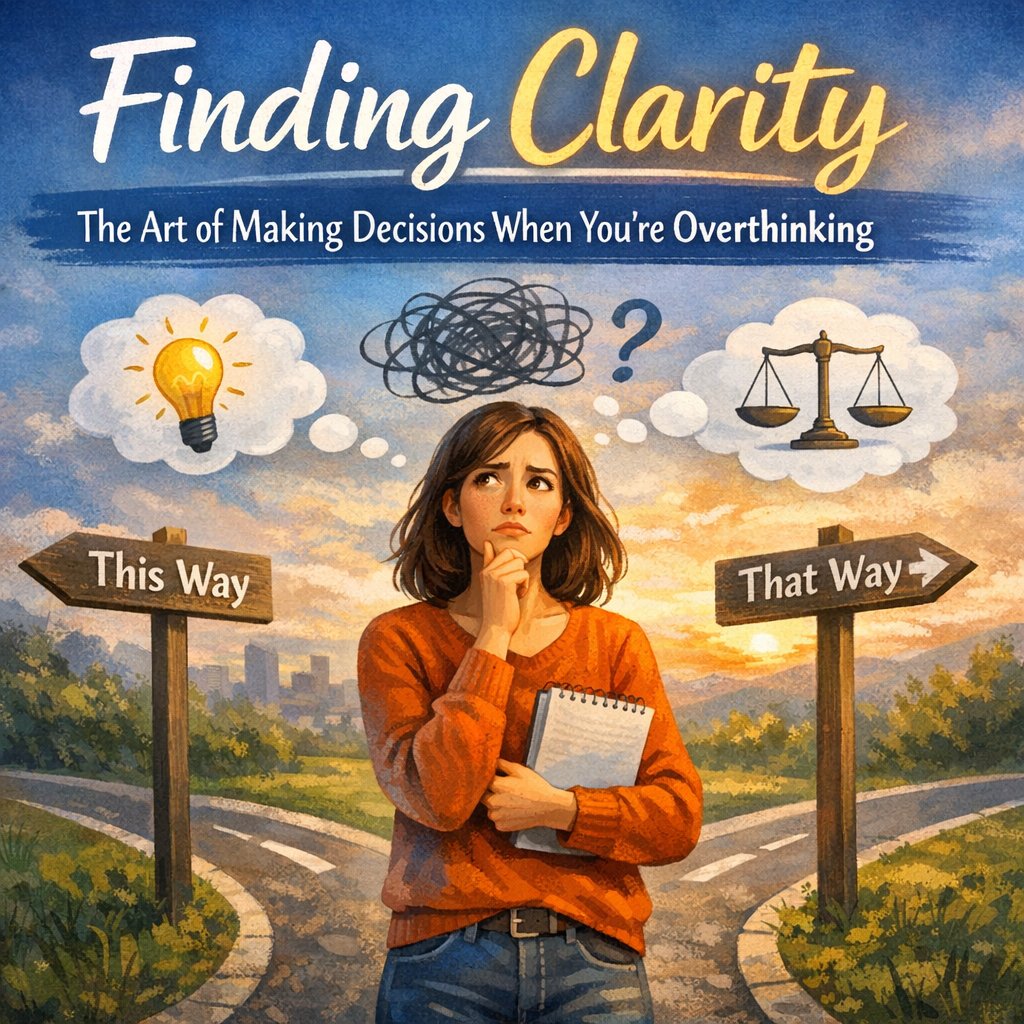
When overthinking takes over, decision‑making becomes harder not because you’re incapable, but because your mind is trying to protect you from uncertainty, regret, or emotional discomfort. If this pattern ever begins to interfere with sleep, daily functioning, or your overall well‑being, it’s important to reach out to a qualified mental‑health professional who can help you explore these feelings safely. Within everyday life, though, there are practical ways to reduce mental noise and create a clearer path toward choices that feel grounded rather than pressured.
Understanding the forces that drive overthinking
Overthinking rarely appears out of nowhere. It’s usually a response to something deeper—fear, pressure, past experiences, or a lack of clarity about what matters most. Naming the root helps you interrupt the cycle instead of getting pulled into it.
Common drivers include:
- Fear of negative outcomes, especially when a decision feels high‑stakes.
- External expectations, such as wanting to avoid disappointing others.
- Perfectionism, which frames every choice as a test you must pass.
- Unclear priorities, making it hard to evaluate options.
- Past experiences, especially if previous decisions led to outcomes you didn’t want.
Understanding the emotional trigger shifts your focus from “Why can’t I decide?” to “What part of this feels threatening?”—a far more productive place to work from.
Creating boundaries that contain mental spirals
Overthinking thrives in open‑ended, unstructured situations. Adding boundaries reduces the space where rumination can grow and helps you move from analysis into action.
Helpful boundaries include:
- Setting a decision deadline, even a soft one, to prevent endless revisiting.
- Limiting the number of options, since too much choice increases cognitive load.
- Choosing one or two trusted voices for input instead of crowdsourcing opinions.
- Defining “good enough”, which prevents perfectionism from inflating the stakes.
These boundaries don’t force a rushed decision—they simply prevent your mind from expanding the problem beyond what’s useful.
Using worst‑case thinking as a grounding tool
Imagining the worst‑case scenario may sound counterintuitive, but it often reduces fear rather than amplifying it. When you articulate the worst outcome and how you would handle it, the unknown becomes concrete.
This approach helps because it:
- Shrinks vague fear into something specific and manageable.
- Highlights your coping ability, reminding you that you’ve handled challenges before.
- Clarifies the true stakes, which are often lower than they feel.
Once the fear is named, it loses much of its power, and the decision becomes easier to approach with perspective.
Balancing logic with intuition
Intuition isn’t guesswork—it’s pattern recognition built from experience. When you’re overthinking, your rational mind can drown out intuitive signals that are actually useful.
A balanced approach includes:
- Listing the facts, constraints, and practical considerations.
- Noticing your emotional reactions, which often reveal hidden priorities.
- Asking which option aligns with your long‑term values, not just short‑term comfort.
- Paying attention to the option you keep returning to, even if you can’t fully explain why.
Intuition becomes especially important when the options are equally logical on paper but feel different in your body.
Moving from clarity to commitment
Overthinking often continues because you’re waiting for absolute certainty—a feeling that rarely arrives before action. Clarity tends to emerge after you begin, not before.
Commitment becomes easier when you:
- Accept that no decision guarantees perfection, only direction.
- Focus on adaptability, trusting your ability to adjust if needed.
- Remember that most decisions are reversible, or at least adjustable.
- Celebrate the act of choosing, which builds confidence over time.
Action interrupts rumination. Even a small step creates momentum and reduces the mental fog around the decision.
Building a decision‑making system you can rely on
A repeatable system reduces emotional load and makes decisions feel less personal and more procedural. Over time, this structure becomes a buffer against overthinking.
Useful components include:
- A personal checklist—for example: “Does this align with my values? Do I have enough information? What outcome matters most?”
- A maximum time limit for research or comparison.
- A rule for consultation, such as asking only one trusted person for perspective.
- Writing down your reasoning, which reduces mental clutter and reveals what actually matters.
Systems don’t eliminate emotion—they simply keep it from running the entire process.
Integrating these practices into daily life
Decision‑making becomes easier when you treat it as a skill rather than a test. Each choice is an opportunity to practice clarity, boundaries, and self‑trust. Over time, you build a track record of decisions made with intention rather than fear, which gradually reduces the intensity of overthinking.
As you reflect on your own patterns, which part of the decision‑making process tends to trip you up most often—the fear of choosing wrong, the pressure to get it perfect, or the difficulty of narrowing down options?