

How a Simple Rule Can Transform Your Music Arrangements: Tips for Better Composition
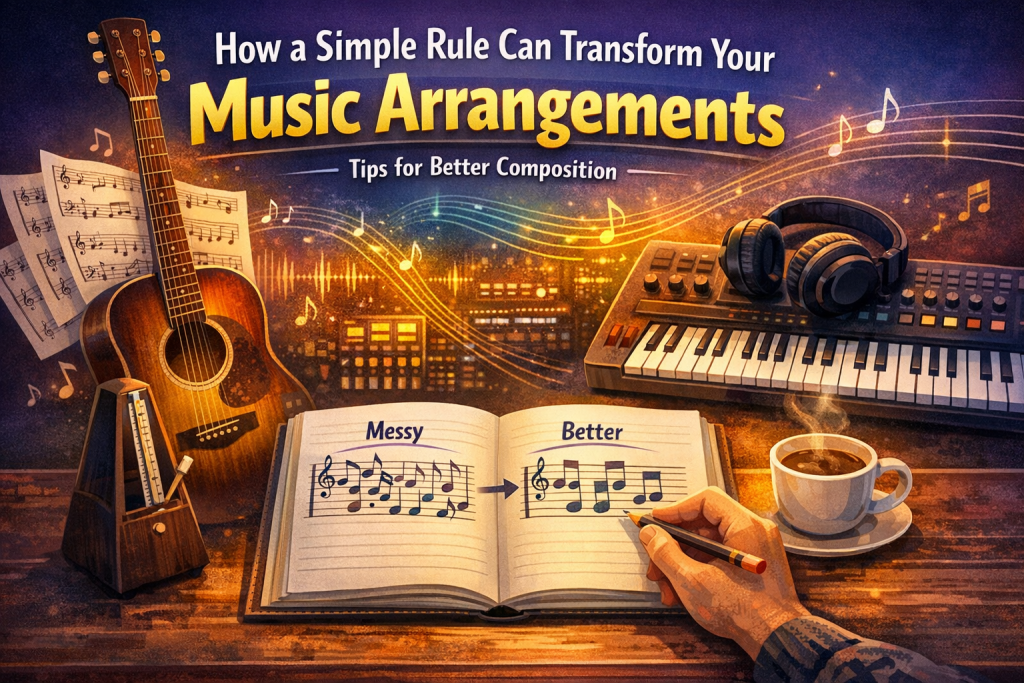
How a Simple Rule Can Transform Your Music Arrangements: Tips for Better Composition
When arranging music, it’s easy to fall into the trap of adding more — more layers, more instruments, more effects — hoping complexity will make your track sound unique. But the truth is, one simple rule can transform your arrangements more than any plugin or extra layer:
Less is more.
Simplicity creates clarity. Clarity creates impact. And impact is what listeners remember.
Here’s how to apply this powerful principle to elevate your compositions and build arrangements that feel intentional, emotional, and professional.
1. Start with a Strong Core Element
Every great arrangement begins with one compelling idea — the anchor of your entire track.
How to Focus on Your Core Element
- Choose one motif: A standout riff, melody, or rhythm should lead the song.
- Remove distractions: Strip away anything that competes with your main idea.
- Let the core breathe: Give your central element space so listeners can connect with it.
A strong idea doesn’t need clutter — it needs support.
2. Limit Your Instrumentation
Too many instruments fighting for space leads to muddiness and confusion. Fewer, well‑chosen elements create a cleaner, more powerful arrangement.
How to Simplify Instrumentation
- Use complementary sounds: Pair instruments that enhance each other rather than compete.
- Respect frequency ranges: Avoid stacking too many mid‑range instruments.
- Give every sound a purpose: If it doesn’t add value, remove it.
Minimalism isn’t emptiness — it’s intention.
3. Build Dynamics Through Subtraction
Dynamics aren’t only created by adding layers — often, removing elements is far more effective.
How to Create Dynamic Arrangements
- Start small: Begin with minimal instrumentation and build gradually.
- Remove for impact: Drop drums or bass before a chorus to make the drop hit harder.
- Contrast intensity: Quiet verses + full choruses = emotional lift.
Subtraction creates tension, and tension creates excitement.
4. Use Repetition Wisely
Repetition gives your song cohesion — but too much repetition becomes predictable. The key is repeating ideas with subtle variation.
How to Use Repetition Effectively
- Repeat with variation: Change rhythm, instrumentation, or phrasing.
- Call‑and‑response: Let one instrument or vocal phrase answer another.
- Evolve loops: Add small changes every few bars to keep loops fresh.
Repetition builds familiarity; variation keeps listeners engaged.
5. Create Contrast for Interest
Contrast is one of the most powerful tools in arrangement. It makes each section feel distinct and emotionally meaningful.
How to Add Contrast
- Energy shifts: Quiet verses, explosive choruses.
- Rhythmic changes: Switch patterns or simplify grooves.
- Harmonic contrast: Change chords or modulate for a fresh feel.
Contrast is what makes the chorus feel like the chorus.
6. Focus on Transitions
Smooth transitions keep your song flowing naturally. Abrupt changes can break immersion unless they’re intentional.
How to Improve Transitions
- Use effects: Reverb swells, filter sweeps, or delays can bridge sections.
- Add fills: Short drum fills or vocal pickups prepare the listener.
- Control energy: Gradually shift intensity rather than jumping suddenly.
Great transitions make your arrangement feel seamless and professional.
7. Edit Ruthlessly
Editing is where good arrangements become great. The willingness to remove unnecessary elements is a superpower.
How to Edit Your Arrangement
- Ask: “Does this serve the song?” If not, cut it.
- Simplify cluttered sections: Reduce layers until the idea is clear.
- Listen with fresh ears: Take breaks and return with perspective.
Your arrangement becomes stronger every time you remove something unnecessary.
Final Thoughts
“Less is more” may sound simple, but it’s one of the most transformative principles in music arrangement. By focusing on a strong core idea, limiting instrumentation, using subtraction for dynamics, creating contrast, and editing with intention, you can craft arrangements that feel clear, powerful, and emotionally resonant.
Simplicity isn’t a limitation — it’s a strategy. When you let your ideas breathe, they shine.
Next time you’re arranging a track, try stepping back instead of adding more. You might be surprised by how much stronger your music becomes.