

Mastering Your Mix: Common Mixing Problems and Solutions
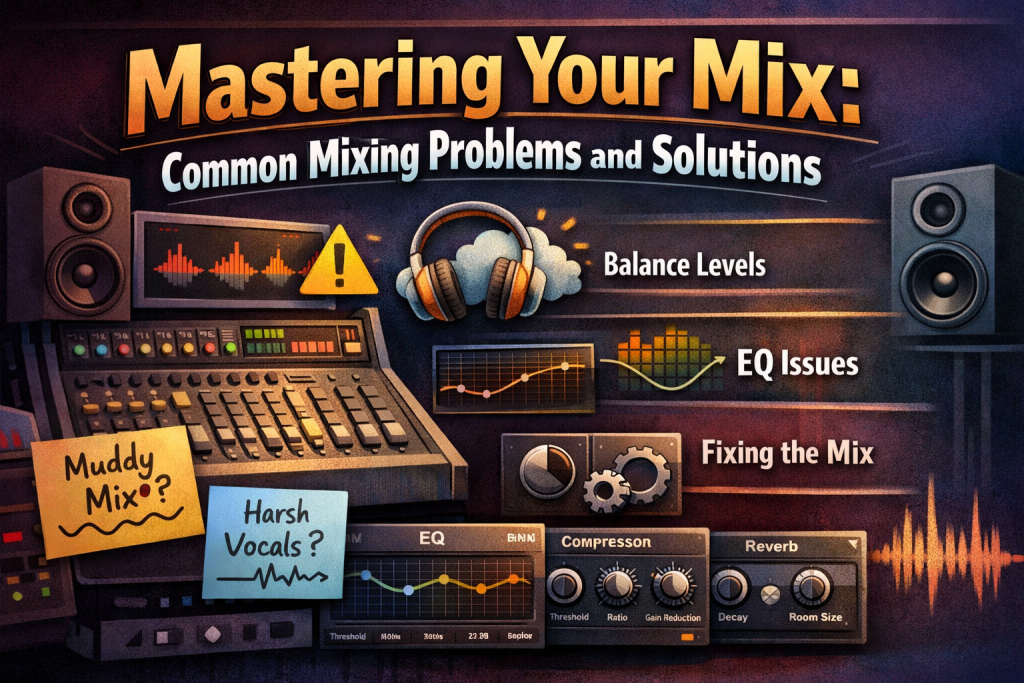
Mastering Your Mix: Common Mixing Problems and Solutions
Mixing is an art — one that can transform a good track into a great one. But even experienced producers run into issues that make a mix sound muddy, harsh, flat, or unbalanced. The good news is that most mixing problems have clear, practical solutions.
Here’s a comprehensive guide to the most common mixing challenges and how to fix them so you can master your mix with confidence.
1. Muddy Mixes
A muddy mix lacks clarity and definition. Instruments blur together, especially in the low‑mid frequencies.
Why It Happens
- Too many instruments occupying the same low‑mid range
- Excessive low‑end buildup
- Lack of EQ separation
How to Fix It
- High‑Pass Filter: Remove unnecessary low frequencies from vocals, guitars, synths, and percussion.
- Cut Low‑Mids (200–500 Hz): This is where mud often lives. Apply gentle cuts to clean up the mix.
- Sidechain Compression: Duck the bass slightly when the kick hits to prevent low‑end clashes.
2. Harsh Highs
Harshness makes a mix fatiguing and unpleasant. It often shows up in vocals, cymbals, and bright instruments.
Why It Happens
- Over‑boosted high frequencies
- Excessive sibilance
- Poor microphone technique
How to Fix It
- Use a De‑Esser: Target sibilance in the 4–10 kHz range.
- EQ Cuts: Identify harsh frequencies and apply subtle reductions.
- Add Saturation: Warm, gentle saturation smooths out brittle highs.
3. Weak Vocals
Vocals are the emotional center of most songs. If they sound buried or thin, the entire mix suffers.
Why It Happens
- Poor gain staging
- Competing frequencies
- Lack of compression or presence
How to Fix It
- Compression: Use a 3:1 or 4:1 ratio to control dynamics and keep vocals consistent.
- EQ Boosts: Add presence around 3–6 kHz and air around 10–12 kHz.
- Reverb/Delay: Use subtle effects to add depth without pushing vocals backward.
4. Overcrowded Mix
Too many elements fighting for space creates chaos and listener fatigue.
Why It Happens
- No panning strategy
- Frequency overlap
- Overuse of effects
How to Fix It
- Panning: Spread guitars, keys, and backing vocals across the stereo field.
- Subtractive EQ: Carve out space for each instrument.
- Use Reverb Wisely: Too much reverb makes mixes washy — keep it intentional.
5. Lack of Depth
A flat mix feels lifeless and one‑dimensional.
Why It Happens
- Everything is the same volume
- No contrast between foreground and background
- Underuse of spatial effects
How to Fix It
- Volume Automation: Bring elements forward or back during key moments.
- Reverb/Delay: Use short reverbs for close sounds and longer ones for distant elements.
- Layering: Combine dry and wet signals to add dimension.
6. Over‑Compression
Too much compression kills dynamics and makes a mix sound squashed.
Why It Happens
- High ratios
- Low thresholds
- Fast attack/release settings
How to Fix It
- Use Lower Ratios: Start with 2:1 or 3:1.
- Parallel Compression: Blend compressed and uncompressed signals.
- Adjust Attack/Release: Slow attack preserves transients; fast release keeps energy.
7. Stereo Imbalance
A lopsided mix feels unnatural and distracting.
Why It Happens
- Uneven panning
- Overly wide stereo effects
- Phase issues
How to Fix It
- Check Panning: Ensure elements are balanced left and right.
- Mid/Side Processing: Adjust center vs. sides for better cohesion.
- Mono Compatibility: Regularly check your mix in mono to catch phase problems.
8. Lack of Energy
A mix without energy feels dull, even if the song itself is strong.
Why It Happens
- Weak transients
- No dynamic contrast
- Underdeveloped arrangement
How to Fix It
- Automation: Build tension and release with volume and effect changes.
- Enhance Transients: Use transient shapers or slow‑attack compression.
- Layer Percussion: Add shakers, claps, or cymbals to lift key sections.
Conclusion
Mixing is both technical and creative — and every challenge you face is an opportunity to refine your skills. By understanding these common problems and applying the right solutions, you can create mixes that are clear, dynamic, balanced, and emotionally impactful.
Trust your ears. Experiment boldly. And remember: every great mix is built through practice, patience, and intentional decision‑making.