

The Complete Guide to Sustainable Habits for Busy People
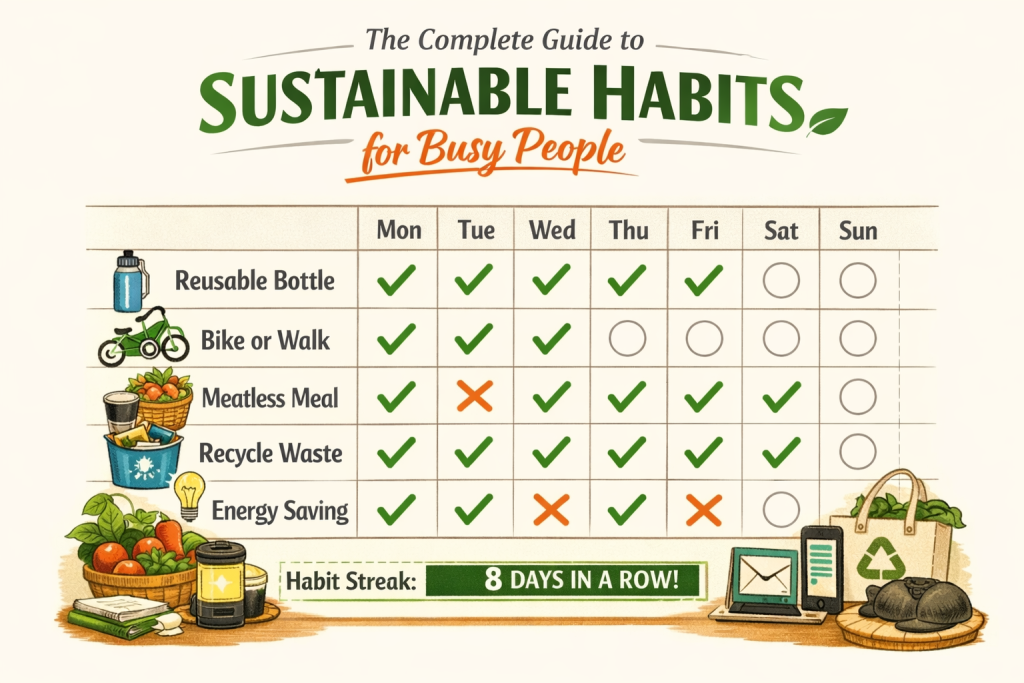
Small, repeatable habits are the most reliable path to sustainable living when your days are already full. The goal is to make low‑impact choices the easiest choices—tiny shifts that save time, money, and resources while fitting into your existing routines. The sections below give a practical, evidence‑informed playbook you can use immediately, plus simple systems to keep momentum without adding stress.
Why small habits work for busy people
Small habits reduce friction because they require little decision‑making and slot into routines you already have. When repeated, they compound into measurable impact: collective adoption of short daily actions can reduce individual footprints meaningfully over time. Evidence on habit formation shows that cue‑based, tiny actions are far easier to sustain than large, sporadic efforts. superkynd.com ijfmr.com
Core habit categories (what to start with)
🥗 Meal planning — Plan once, save time and waste.
Create a weekly menu from what’s already in your pantry, batch‑cook one or two staples, and store leftovers in reusable containers to cut food waste and last‑minute takeout. Meal planning reduces impulse purchases and packaging, and it often lowers grocery bills. Impactful Ninja superkynd.com
♻️ Reusables — Make the sustainable choice the default.
Keep a durable water bottle, travel mug, reusable bags, and a set of food containers where you’ll grab them (car, bag, or by the door). These swaps eliminate frequent single‑use items with zero ongoing time cost once they’re habit. worldreporter.com
💡 Energy habits — Small actions, steady savings.
Turn off lights when leaving rooms, unplug chargers and idle devices, run full loads of laundry/dishes, and favor natural light when possible. These micro‑habits reduce electricity use and utility bills without extra time investment. superkynd.com
🚶 Transport choices — Reduce emissions without radical change.
Walk or bike for short trips, combine errands into one route, carpool, or use public transit when practical. Even occasional shifts away from solo driving lower fuel costs and emissions. stormywheather.com
🛍️ Mindful purchasing — Buy less, choose better.
Ask whether you truly need an item, prefer durable or second‑hand goods, and favor brands with transparent sustainability commitments. Buying with intention reduces waste and supports better industry practices. mediamanager.sei.org
🌱 Compost & bulk — Reduce packaging and food waste.
Start a small countertop compost bin or use a local drop‑off; buy pantry staples in bulk with your own jars when possible. These steps cut landfill waste and packaging at the source. Impactful Ninja superkynd.com
Quick routines you can adopt this week
- Daily (2–10 minutes) — Check the fridge for leftovers before ordering food; fill your reusable bottle; unplug one unused charger.
- Weekly (20–40 minutes) — Plan 3–4 meals, prep one batch‑cook item, and set out reusables for the week.
- Monthly (30–60 minutes) — Audit pantry for bulk buys, declutter one category with a one‑in/one‑out rule, and review subscriptions or recurring purchases.
These timeboxes make sustainability predictable and low‑effort.
Systems and tools that reduce decision fatigue
- Staging zones — Keep reusables in a visible, grab‑and‑go spot (door hook, car trunk, work bag).
- Simple checklists — A 3‑item pre‑departure checklist (bottle, bags, lunch) prevents forgetfulness.
- Automation — Switch to paperless billing and set recurring orders only for essentials to avoid impulse buys.
- One habit at a time — Add a new habit only after the previous one feels automatic (usually 3–6 weeks). ijfmr.com
Troubleshooting common obstacles
- “I forget my reusables.” — Keep spares in the car or at work and attach a visual cue (sticky note by keys).
- “Meal planning feels time‑consuming.” — Start with planning just three dinners and use repeatable templates (grain + veg + protein).
- “Bulk buying seems expensive up front.” — Buy one frequently used item in bulk to test savings and storage needs.
- “I feel guilty when I slip.” — Treat lapses as data, not failure; adjust cues or simplify the habit rather than abandoning it. ijfmr.com
How to scale impact without adding stress
- Leverage existing routines — Attach a new eco‑habit to a habit you already do (habit stacking).
- Make it social — Share a meal‑prep session with a friend or swap reusables tips in a group chat to normalize the behavior.
- Measure small wins — Track one metric (e.g., number of single‑use cups avoided per week) to see progress.
- Choose high‑leverage swaps — Prioritize actions that reduce recurring waste (reusables, meal planning, composting) before one‑off purchases. superkynd.com
Practical starter checklist (do this today)
- Put a reusable bottle and bag by your keys.
- Plan one dinner using what’s already in your fridge.
- Unplug one charger and turn off an unused light.
- Switch one monthly bill to paperless.
Completing these four items creates immediate, low‑effort impact and builds momentum.
Takeaway: Start with one tiny habit and make it automatic—that single change will create the space and confidence to add the next. Which one small habit would you like to lock in this week—meal planning, carrying reusables, an energy habit, or switching a bill to paperless?