

The 5 Minute Rule: How to Start Anything When You Don’t Feel Like It
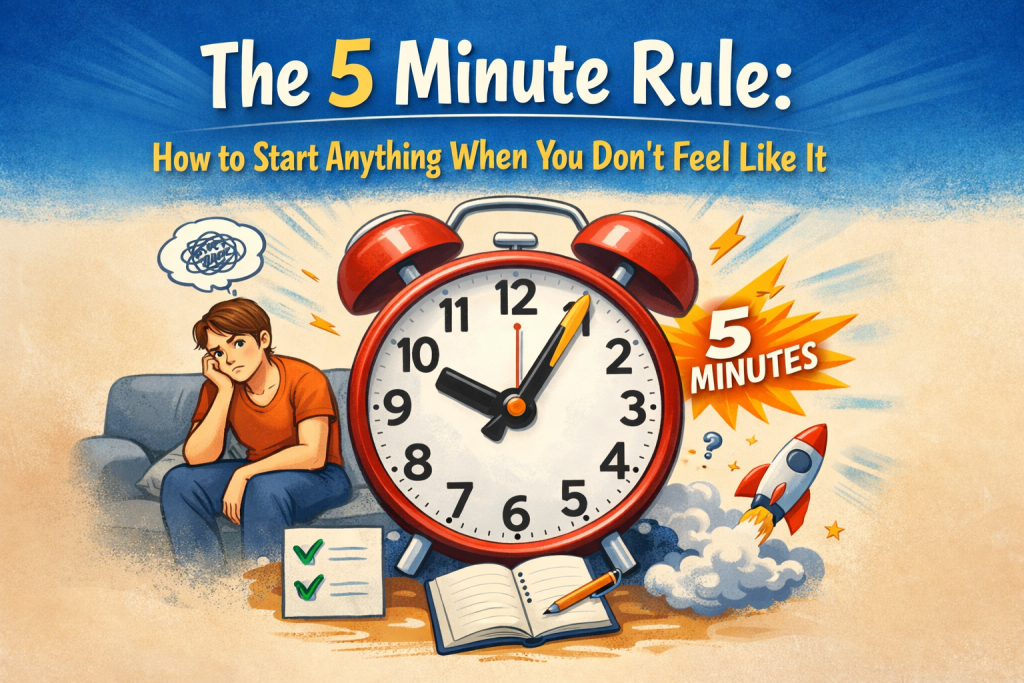
The 5‑Minute Rule works because it dismantles the single biggest barrier to progress: the psychological weight of beginning. When a task feels too big, too vague, or too draining, your brain interprets it as a threat to energy and comfort.
The 5‑Minute Rule bypasses that resistance by shrinking the commitment to something so small that your mind no longer fights it. What follows is a full, long‑form exploration of how this rule works, why it’s so effective, and how to use it to build lasting momentum across every area of your life.
Why Starting Is the Hardest Part
Procrastination is rarely about laziness. It’s about emotional friction—uncertainty, overwhelm, fear of failure, perfectionism, or simply the discomfort of switching mental states. When you’re staring at a task that feels large or ambiguous, your brain exaggerates the difficulty and underestimates your ability to handle it.
This creates a loop:
- The task feels big.
- You avoid it to reduce discomfort.
- Avoidance increases anxiety.
- Anxiety makes the task feel even bigger.
The 5‑Minute Rule interrupts this loop by lowering the activation barrier. Instead of asking, “Can I finish this?” you ask, “Can I do five minutes?” The answer is almost always yes.
The Psychology Behind the 5‑Minute Rule
The rule works because it aligns with how the brain evaluates effort and reward. When a task feels manageable, the brain stops triggering avoidance and allows you to begin. Once you start, several psychological mechanisms kick in.
Momentum Activation
Beginning creates a shift in cognitive state. You move from avoidance to engagement, and the brain prefers to continue what it has already started.
Dopamine Reward
Completing even a tiny amount of work triggers a dopamine release. This reinforces the behavior and makes you more likely to continue.
Reduced Perfectionism
A five‑minute window removes the pressure to perform perfectly. You’re not trying to produce a masterpiece—you’re just showing up.
Identity Shift
Each small session reinforces the belief: “I’m someone who takes action.” Identity‑based habits are far more durable than motivation‑based ones.
The 5‑Minute Rule is not about tricking yourself. It’s about working with your brain’s natural wiring instead of fighting it.
How the 5‑Minute Rule Builds Long‑Term Consistency
Consistency is built through repetition, not intensity. Five minutes a day is more powerful than an hour once a week because it keeps the habit alive. It keeps the project warm. It keeps you connected to the work.
Over time, five minutes becomes:
- Ten minutes
- Twenty minutes
- A full session
- A sustainable routine
Even on days when you only do the minimum, you maintain the habit loop. You avoid the cold‑start friction that makes restarting so difficult.
Why Small Steps Compound
Small actions accumulate because they create a chain reaction. Five minutes of writing becomes a paragraph. Five minutes of cleaning becomes a tidy corner. Five minutes of exercise becomes a warm‑up that leads to a full workout.
The rule isn’t about the size of the action—it’s about the direction of the movement.
Applying the 5‑Minute Rule to Different Areas of Life
The beauty of the rule is its universality. It works across creative, personal, and practical domains because the underlying psychology is the same.
Creative Work
- Write for five minutes.
- Sketch for five minutes.
- Brainstorm ideas for five minutes.
Creativity thrives on low‑pressure beginnings.
Household Tasks
- Wash dishes for five minutes.
- Tidy one surface.
- Sort one drawer.
Small bursts prevent overwhelm and build a sense of control.
Health and Wellness
- Stretch for five minutes.
- Walk for five minutes.
- Do a short breathing exercise.
Micro‑sessions reduce resistance and build healthy routines.
Professional Tasks
- Answer emails for five minutes.
- Outline a project for five minutes.
- Review notes for five minutes.
The rule helps you break through the inertia of complex or ambiguous tasks.
Why the Rule Works Even When You Stop at Five Minutes
Many people assume the rule only works if it leads to more work. But the real power lies in the fact that it works even when you stop at the five‑minute mark.
Stopping after five minutes still gives you:
- A completed micro‑win
- A maintained habit
- Reduced anxiety
- A sense of progress
- A stronger identity as someone who takes action
Progress is progress, no matter the size. The goal is not perfection—it’s movement.
How to Use the 5‑Minute Rule Effectively
To get the most out of the rule, treat it as a tool, not a test. The goal is to make starting easy and sustainable.
Keep the Task Specific
“Work on my book” is vague.
“Write for five minutes” is actionable.
Remove Barriers
Have your tools ready.
Keep your workspace accessible.
Eliminate unnecessary steps.
Pair It With a Cue
A cue anchors the habit.
Examples: after coffee, after lunch, before bed.
Celebrate the Win
Acknowledge the effort.
Reinforce the identity.
Let the brain register success.
Allow Yourself to Stop
Stopping after five minutes is not failure—it’s the rule working as intended.
The 5‑Minute Rule as a Gateway to Flow
Flow rarely appears at the beginning of a task. It emerges after you’ve crossed the threshold of engagement. The 5‑Minute Rule gets you to that threshold quickly and gently.
Once you begin:
- Your attention narrows
- Your mind settles
- Your resistance fades
- Your focus deepens
Many people find that once they start, they naturally continue far beyond the five‑minute mark. But even when they don’t, they’ve still strengthened the habit loop.
Why the Rule Is So Effective for Procrastinators
Procrastination is not a time problem—it’s an emotional regulation problem. The 5‑Minute Rule reduces emotional friction by shrinking the task to something that feels safe and doable.
It helps you:
- Reduce overwhelm
- Lower perfectionistic pressure
- Break the freeze response
- Build trust in your ability to begin
- Replace avoidance with action
It’s a compassionate, realistic approach to productivity—one that honors your psychology instead of fighting it.
Building a Life Around Small, Consistent Starts
The 5‑Minute Rule is more than a productivity hack. It’s a philosophy of gentle beginnings. It teaches you that progress doesn’t require intensity, motivation, or perfect conditions. It requires willingness. It requires presence. It requires five minutes.
Over time, those five‑minute sessions accumulate into:
- Finished projects
- Strengthened habits
- Reduced anxiety
- Increased confidence
- A more resilient creative identity
The rule reminds you that you don’t need to feel ready to begin. You just need to begin.
As you think about your current goals, what’s one task or project that feels heavy enough that a five‑minute start might make all the difference today?