

The Art of Slow Mornings: Why Rushing Is Ruining Your Day
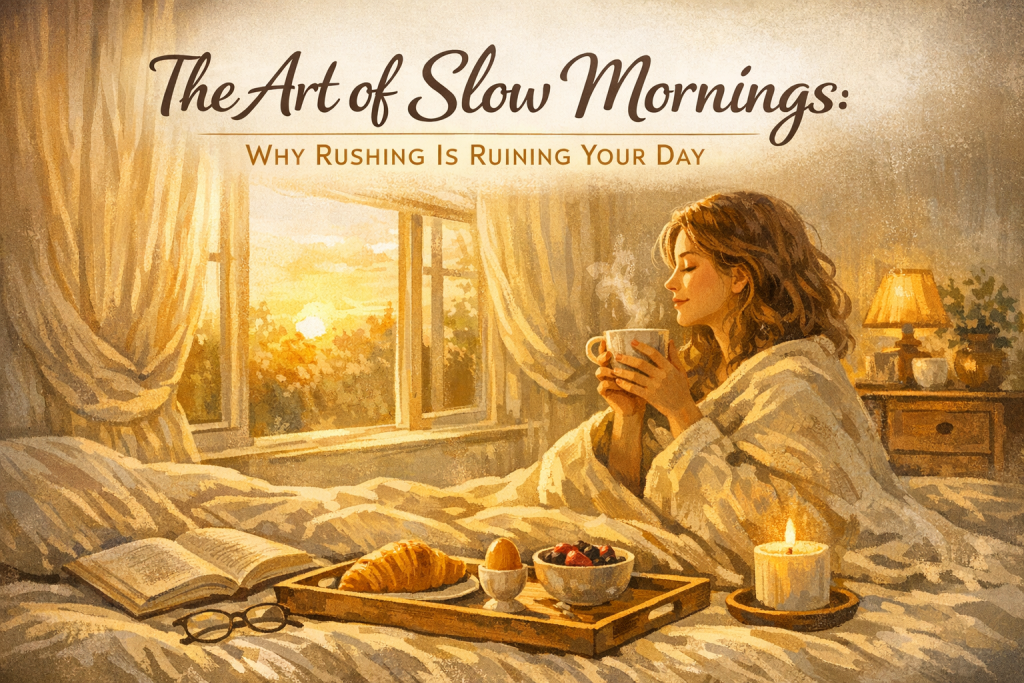
Slow mornings reshape the entire emotional tone of your day because they shift your nervous system out of urgency and into presence. When you begin the morning in a rush, your body interprets that pace as a threat—your stress hormones spike, your attention fragments, and your mind enters the day already braced for impact. A slow morning interrupts that cycle. It gives your brain time to regulate, your body time to wake naturally, and your mind time to orient before the world begins asking things of you. That early calm becomes the baseline you carry into everything that follows.
Why rushing destabilizes your internal state
A rushed morning doesn’t stay in the morning. It sets off a chain reaction that affects your focus, mood, and resilience for hours afterward.
When you wake and immediately accelerate into tasks, notifications, and decisions, your nervous system interprets the pace as danger. This creates:
- Elevated cortisol, which makes you more reactive and less patient
- Shallow breathing, which reduces mental clarity
- Fragmented attention, making it harder to prioritize
- A heightened threat response, causing small frustrations to feel bigger
This early activation primes your brain to stay in “fight‑or‑flight,” which drains energy and makes the day feel harder than it needs to be.
How slow mornings regulate your nervous system
A slow morning isn’t about doing less—it’s about doing the first things with intention. Even five minutes of calm can shift your physiology into a more grounded state.
This shift creates:
- A steadier emotional baseline, so you’re less reactive
- Greater mental clarity, making decisions easier
- More capacity for problem‑solving, because your brain isn’t overloaded
- A calmer response to stress, even when the day gets busy
This regulation is what makes slow mornings restorative rather than indulgent. You’re not wasting time—you’re setting the conditions for a better day.
Elements that make a slow morning effective
Slow mornings work best when they include small, grounding rituals that ease the transition from sleep to wakefulness. These rituals don’t need to be elaborate; they just need to be intentional.
Useful elements include:
- Sitting with a warm drink before checking your phone
- Reading a few pages of something nourishing
- Stretching or taking a short walk to wake your body gently
- Journaling a few lines to orient your mind
- Preparing breakfast without multitasking, letting the process be slow
The power comes from consistency, not complexity. A simple ritual repeated daily has more impact than an elaborate routine you can’t sustain.
The ripple effect on productivity and well‑being
A calm start creates a cognitive advantage. When your mind isn’t flooded with stress hormones, you think more clearly, prioritize more effectively, and move through tasks with less friction.
Slow mornings also strengthen emotional resilience:
- You’re less reactive to interruptions
- You recover faster from stress
- You make decisions with more clarity
- You feel more grounded and patient
Over time, this becomes a self‑reinforcing cycle: calm mornings lead to calmer days, which make it easier to maintain calm mornings.
Making slow mornings realistic in a busy life
You don’t need an hour of serenity to benefit. Even five to ten minutes of intentional slowness can shift your internal state.
Practical ways to make it doable:
- Protect a small window of time that belongs only to you
- Wake slightly earlier if needed, but only by a few minutes
- Simplify your morning tasks so you’re not rushing by default
- Remove one early‑day stressor, like checking messages immediately
- Prepare small things the night before, such as clothes or breakfast ingredients
The goal is rhythm, not perfection. A slow morning is a practice, not a performance.
Integrating slow mornings into your identity
When slow mornings become part of your identity—“I’m someone who starts the day calmly”—they stop feeling like a luxury and start feeling like a necessity. Over time, you’ll notice:
- You handle stress with more ease
- You feel more grounded throughout the day
- You’re less reactive and more intentional
- You have more emotional bandwidth for creativity and connection
Slow mornings aren’t about doing less—they’re about creating the conditions for a better version of yourself to show up.
As you think about your own mornings, what’s one small shift that would make your first few minutes of the day feel calmer and more intentional?