

How to Use the Circle of Fifths for Songwriting: Unlock Creative Chord Progressions and Key Changes
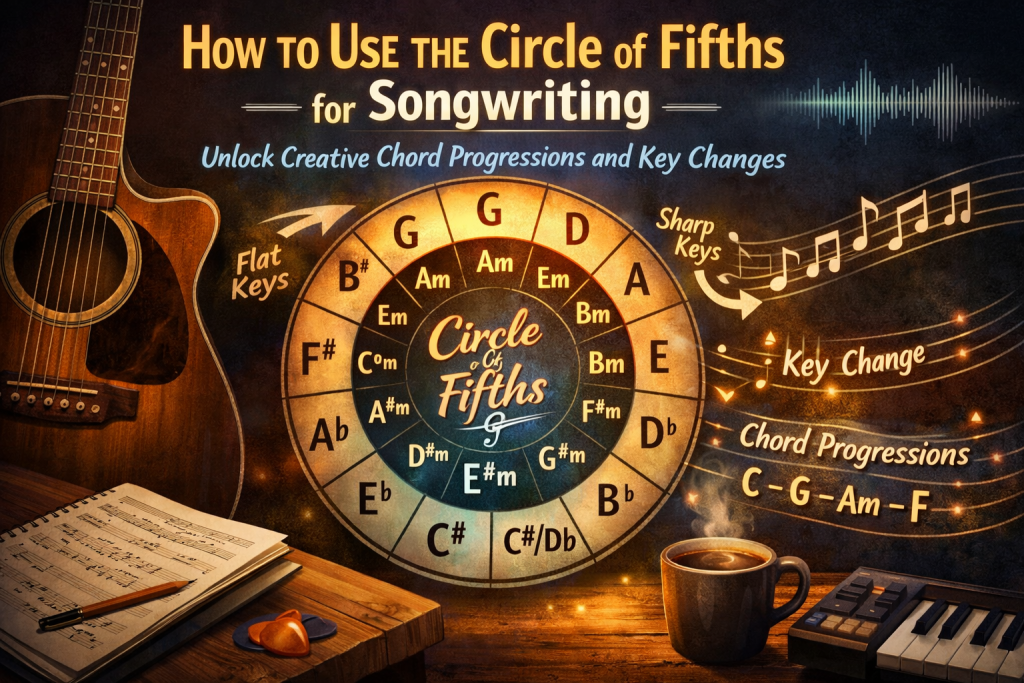
How to Use the Circle of Fifths for Songwriting: Unlock Creative Chord Progressions and Key Changes
How do you use the Circle of Fifths for songwriting as a beginner?
If the Circle of Fifths has ever looked confusing or overly technical, you’re not alone — most musicians first see it as a strange wheel of symbols and sharps that feels more like a puzzle than a songwriting tool. But once you understand what it’s actually showing you, it becomes one of the simplest ways to build chord progressions, understand which chords fit together, and explore key changes with confidence. This guide breaks down the Circle of Fifths in a truly beginner‑friendly way, showing you how to use it to write natural‑sounding progressions, create smooth transitions, and add emotional depth to your music without needing any formal theory background.
If you’ve ever looked at the Circle of Fifths and thought, “This looks like a clock someone made during a fever dream,” you’re not alone. Most musicians first encounter it as a mysterious wheel full of symbols, sharps, flats, and vibes. But once you understand what it’s actually showing you, the Circle of Fifths becomes one of the most supportive, creativity‑boosting tools in your songwriting life.
This guide is designed for real beginners — people who want to write songs, not decode ancient runes. You’ll learn how to use the circle to:
- build chord progressions that feel natural
- understand which chords “belong together”
- create smooth transitions between sections
- explore key changes without fear
- add color, tension, and emotional depth
And you’ll do it without needing a theory degree or a tolerance for jargon.
Let’s make the Circle of Fifths feel like a friend instead of a test.
1. What the Circle of Fifths Actually Is (In Plain Language)
Imagine you’re standing in the middle of a room with 12 doors around you — one for each musical key. The Circle of Fifths is basically a map showing how close or far those doors are from each other.
That’s it. It’s a map of musical neighborhoods.
Here’s the simple version:
- Moving clockwise takes you to keys that feel bright, open, and closely related.
- Moving counterclockwise takes you to keys that feel warm, mellow, or slightly darker — also closely related.
- Every major key has a relative minor, like a roommate who shares the same notes but has a different personality.
If you remember nothing else, remember this:
Keys that sit next to each other on the circle share a lot of notes. That’s why they sound good together.
This one idea unlocks almost everything else.
2. How to Build Chord Progressions Using the Circle (Without Overthinking)
Most beginners struggle with chord progressions because it feels like there are infinite choices. The Circle of Fifths shrinks that infinity down to something manageable and intuitive.
Start with your home base (your key).
Let’s say you’re writing in C major. On the circle, C sits between F and G.
Those three chords — C, F, and G — are the classic “home base” chords in countless songs. They feel stable, familiar, and emotionally grounded.
Why do they work so well?
Because they’re neighbors. They live right next to each other on the circle.
Try this progression:
- C → F → G → C It’s simple, but it works in pop, folk, rock, worship, country — everywhere.
Want something with more movement?
Move clockwise:
- C → G → D → A
This creates a feeling of forward motion, like the song is leaning into the next moment.
Want something softer or more emotional?
Use the relative minor:
- C major → A minor
A minor is the “gentle shadow” of C major — same notes, different mood.
Beginner takeaway
If you’re stuck, pick your key and use the chords sitting next to it. They will always sound good together.
This alone can unblock entire songs.
3. How to Use the Circle for Smooth Key Changes (Even If You’ve Never Tried One)
Key changes can feel intimidating, but the circle makes them surprisingly approachable.
Think of it like walking from one neighborhood to another:
- Next‑door neighborhoods feel natural and smooth.
- Across‑town neighborhoods feel dramatic and bold.
Smooth, subtle key changes
Move to a key right next to your current one.
Examples:
- C → G
- C → F
These keys share most of their notes, so the listener barely feels the shift — it just feels like the song opened a window.
Emotional mood shifts
Move from a major key to its relative minor.
Examples:
- C major → A minor
- G major → E minor
This is the musical equivalent of changing the lighting in a room — same space, different emotional tone.
Bold, dramatic key changes
Jump to a key far away on the circle.
Examples:
- C major → A major
- C major → E major
These changes feel like stepping onto a new planet. They’re great for bridges, final choruses, or emotional “lift‑off” moments.
Beginner takeaway
The farther apart two keys are on the circle, the more dramatic the key change will feel.
You get to choose how bold you want to be.
4. Using Secondary Dominants (The Beginner‑Friendly Version)
Secondary dominants sound like a scary concept, but here’s the gentle explanation:
A secondary dominant is just a chord that briefly points toward another chord to make it feel stronger.
Think of it like shining a flashlight on the next chord so the listener notices it more.
Example in C major
You want to land on G (the V chord). To make that G feel extra satisfying, you can play D major before it.
Why D? Because D is the “dominant of G.”
So you get:
- C → D → G
It adds color, tension, and a sense of “leaning forward.”
Why the Circle helps
The circle shows you which chords are a fifth apart — and dominant relationships are built on fifths.
Beginner takeaway
Secondary dominants add spice without changing the whole recipe.
They’re a safe way to make your progressions sound more professional.
5. Creative Chord Substitutions (Beginner‑Safe Ways to Add Flavor)
Chord substitutions are like swapping ingredients in a recipe while keeping the dish recognizable.
The Circle of Fifths helps you find chords that can replace others without sounding wrong.
Substitution example
In C major, the V chord is G major. A softer substitute is E minor (the iii chord).
Try:
- C → E minor → F → C
It feels familiar but gentler.
Borrowed chords
Borrowing from the parallel minor (C minor) adds emotional color.
Examples:
- A♭ major
- E♭ major
- B♭ major
These chords add richness, nostalgia, or cinematic depth.
Why the circle helps
Borrowed chords often come from nearby keys on the circle — so you can visually see which ones will blend well.
Beginner takeaway
Substitutions let you personalize your progressions without confusing your listener.
You stay grounded while exploring.
6. Using Diminished Chords (The Beginner‑Friendly, Non‑Scary Version)
Diminished chords often get a bad reputation because they sound tense or unstable. But that’s their job — they create suspense that resolves beautifully.
The simplest way to use them
Use a diminished chord as a passing chord.
Example in C major:
- B diminished → C
It creates a tiny moment of “leaning in” before the resolution.
Why the circle helps
Diminished chords naturally sit between the stable chords on the circle, helping you understand where they want to go.
Beginner takeaway
Diminished chords are seasoning — use a little, and your progression instantly feels more expressive.
You don’t need to understand the full theory to use them well.
7. Putting It All Together: A Beginner‑Safe Songwriting Workflow
Here’s a gentle, step‑by‑step way to use the Circle of Fifths in real songwriting:
Step 1 — Pick your key.
Choose one that feels comfortable on your instrument.
Step 2 — Find your “home base” chords.
Use the key plus the two neighbors on the circle.
Step 3 — Add emotional color.
Try the relative minor or a borrowed chord.
Step 4 — Add movement.
Experiment with moving clockwise (fifths) for momentum.
Step 5 — Add tension.
Use a secondary dominant or a diminished passing chord.
Step 6 — Explore transitions.
If you want a new section, move to a nearby key.
Step 7 — Trust your ears.
The circle is a guide, not a rulebook.
Final Thoughts: The Circle of Fifths Is a Map, Not a Test
The Circle of Fifths isn’t something you “master.” It’s something you use — like a compass, a color wheel, or a recipe book.
You don’t need to memorize it. You don’t need to understand every theoretical detail. You don’t need to be “good at theory.”
You just need to know this:
The Circle of Fifths shows you which chords and keys naturally get along. Once you see those relationships, songwriting becomes easier, smoother, and more creative.
You’re not learning rules — you’re learning possibilities.
Further Reading:
Resources to help you go deeper
- explore Fast-Track Your Songwriting Career
- check out The Emotional Hooks Handbook
- grab your copy of Write a Song in a Day