

From Chaos to Clarity: How to Turn a Messy Idea Into a Clear Outline
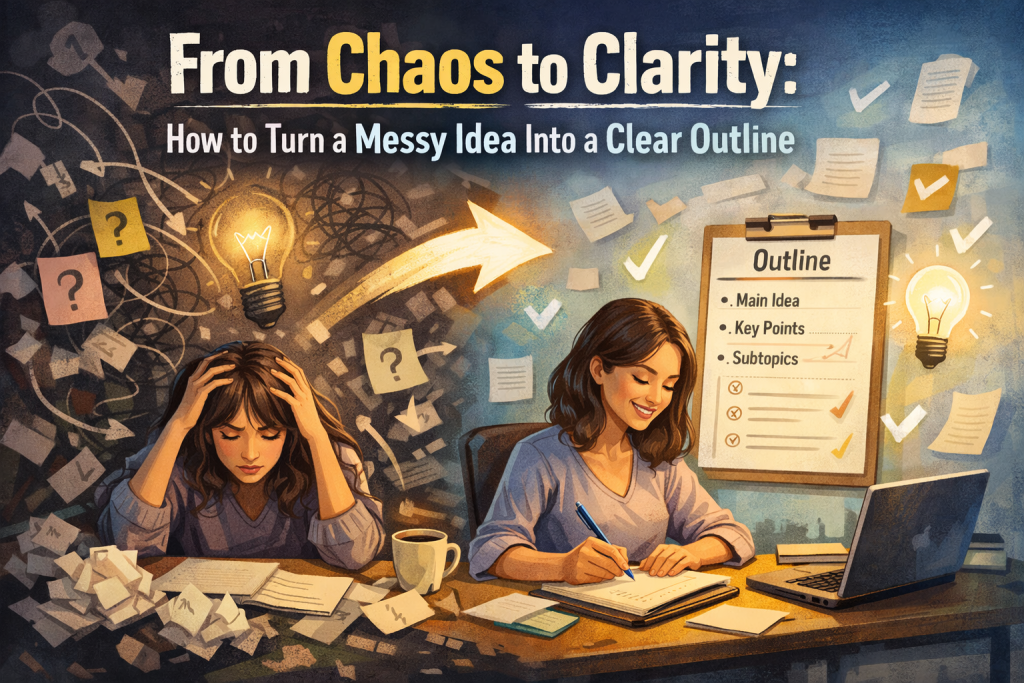
Turning a messy idea into a clear outline is one of the most powerful skills in creative and professional work. A strong outline doesn’t just organize your thoughts—it sharpens your thinking, reveals gaps, and gives you a roadmap you can actually follow. When you learn to move from chaos to clarity with intention, every project becomes easier to start, easier to shape, and easier to finish. This process is essential, guiding you From Chaos to Clarity: How to Turn a Messy Idea Into a Clear Outline.
Why messy ideas feel overwhelming
Messy ideas are rarely the problem—the lack of structure is. When thoughts are swirling in your mind, they compete for attention, overlap, contradict each other, or appear out of order. This creates cognitive overload, making it hard to know where to begin.
A clear outline solves this by:
- Externalizing your thoughts so your brain doesn’t have to hold everything at once
- Revealing patterns you can’t see when ideas stay in your head
- Turning abstract thinking into concrete steps
- Giving you a sense of direction and momentum
The goal isn’t to tame creativity—it’s to give it a container.
Step 1: Brainstorm freely without filtering
Start by getting everything out of your head. Don’t judge, sort, or evaluate yet. The purpose of this step is volume, not precision.
You can brainstorm through:
- A mind map
- A messy list
- Sticky notes
- A voice memo you later transcribe
Let your thoughts spill out. The more raw material you have, the easier the next steps become.
Tip: If you feel stuck, ask yourself:
What am I really trying to say? What problem am I trying to solve? What excites or confuses me about this idea?
Step 2: Group ideas into themes
Once you have a pool of ideas, start clustering them. Look for natural categories, repeated concepts, or ideas that clearly belong together.
Common types of themes include:
- Stages in a process
- Arguments or claims
- Examples or stories
- Problems and solutions
- Causes and effects
- Questions and answers
This step transforms chaos into patterns. You’re not outlining yet—you’re sorting the puzzle pieces into piles.
Step 3: Prioritize what matters most
Not every idea deserves equal weight. Some are core pillars; others are supporting details. Some are interesting but irrelevant.
Ask yourself:
- Which ideas are essential to the message?
- Which ones support or clarify the main point?
- Which ones distract or belong in a different project?
This is where your outline begins to take shape. You’re choosing the spine of your piece.
Step 4: Arrange your ideas in a logical order
Now that you know your main themes and priorities, start shaping the flow. Think about the journey you want the reader—or your future self—to take.
Common structures include:
- Chronological: first → next → then → finally
- Problem–solution: what’s wrong → why it matters → how to fix it
- General to specific: big idea → supporting points → examples
- Compare and contrast: option A → option B → evaluation
- Step-by-step: step 1 → step 2 → step 3
Choose the structure that best fits your purpose, then place your themes in that order.
Step 5: Add transitions to create flow
Even the best ideas fall flat if they feel disconnected. Transitions act as bridges between sections, helping your outline read like a cohesive whole.
Useful transitions include:
- “To understand this better…”
- “Another important factor is…”
- “This leads to…”
- “On the other hand…”
- “Once that’s clear, we can move to…”
These small connectors make your outline feel intentional rather than fragmented.
Step 6: Refine, trim, and clarify
Now that you have a rough outline, polish it. This is where clarity emerges.
Refinement includes:
- Removing redundant ideas
- Clarifying vague points
- Strengthening weak sections
- Ensuring each point supports the main idea
- Checking that the order still makes sense
Your outline should feel clean, logical, and easy to follow.
Step 7: Get feedback to sharpen your thinking
Fresh eyes reveal blind spots. Share your outline with someone who understands the topic or your goals.
Ask them:
- Does the flow make sense?
- Are any sections confusing or unnecessary?
- What feels strongest?
- What feels underdeveloped?
Feedback at the outline stage saves enormous time later.
Why this process works
This approach works because it mirrors how the brain naturally organizes information: from chaos → patterns → priorities → structure → clarity. Instead of fighting your messy idea, you’re partnering with it.
By the end, you have:
- A clear roadmap
- A stronger understanding of your idea
- A structure that supports writing, planning, or presenting
- Confidence in the direction you’re taking
Turning messy ideas into outlines becomes easier every time you practice it.
As you think about your current project, which part of this process feels like it would give you the biggest breakthrough right now—brainstorming freely, grouping themes, or choosing the structure?
Further Reading:
Resources to help you go deeper
- dive deeper with The Musician’s Marketing Playbook
- check out Vulnerable Creator’s Marketing Playbook
- grab your copy of Pitch Yourself Without Cringing
- explore Build a Brand That Feels Like You