

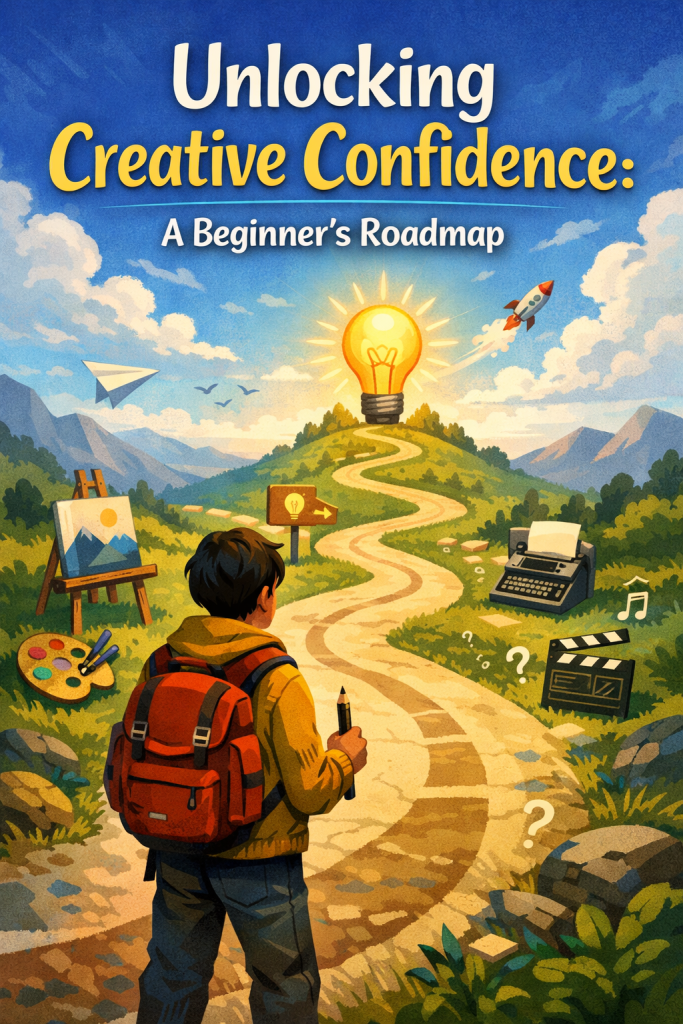
Unlocking Creative Confidence: A Beginner’s Roadmap
How do beginners build creative confidence in a practical, emotionally safe way?
Creative confidence grows when you stop treating creativity as something mysterious and start seeing it as a skill shaped by small experiments, steady practice, and compassionate self‑reflection. Research on creative development shows that confidence increases when beginners take manageable creative risks, track their progress, and build habits that make creativity feel safe rather than high‑stakes. A beginner’s roadmap works best when it blends mindset shifts with simple, repeatable practices — because confidence comes from both how you think and how consistently you show up. This guide breaks down the foundational steps that help new creators build trust in their ideas, strengthen their creative voice, and develop a sustainable practice that grows over time.
Creative confidence grows when you stop treating creativity as something mysterious and start treating it as a skill shaped by experience, reflection, and steady practice. Research on creative development shows that confidence increases when people take small creative risks, observe their own progress, and receive encouragement from others. Psychology Today A beginner’s roadmap works best when it blends mindset shifts with practical habits, because confidence is built from both how you think and how you consistently show up.
One effective way to start building creativity is through journaling. Keeping a creative journal allows you to document your thoughts, sketches, and ideas over time. It serves as a space to experiment with different concepts without the pressure of perfection. For example, you can dedicate a page to mind maps, where you explore various themes or topics that intrigue you. This practice not only enhances your creative thinking but also acts as a confidence booster as you witness your growth over time.
Embracing Experimentation as the Foundation
Consider the impact of engaging in collaborative projects as well. Collaborating with others introduces you to different perspectives and techniques, which can inspire you to try new approaches. For instance, joining a local art class or an online creative community can provide valuable feedback and stimulate your creativity further. Through these interactions, you can learn to appreciate the diverse ways others express themselves creatively, which in turn nurtures your own confidence.
Experimentation removes the pressure to “get it right” and replaces it with curiosity. Early creative efforts often feel fragile, and fear of being “bad” can stop beginners before they start. A low‑stakes, exploratory mindset helps you bypass perfectionism and build resilience through repeated attempts. Creative training programs emphasize that guided mastery—taking small risks and gradually increasing difficulty—reduces fear and builds capability over time. katiekaspari.com
When you treat each attempt as information rather than judgment, failure becomes part of the process instead of a threat to your identity.
Curiosity is fueled by exploration. Take time to visit local galleries, museums, or even nature parks. Engaging with different forms of art can enhance your understanding and appreciation of creative processes. For example, a trip to an art museum can expose you to various styles and techniques from different cultures and time periods. This exposure can spark new ideas and encourage you to experiment with different mediums or subjects in your own work.
Expanding Your Perspective Through Curiosity
Curiosity broadens your creative vocabulary by giving your mind more raw material to work with. New experiences—whether small detours, new media, or deliberate exploration—help you make connections you wouldn’t otherwise see. Creative confidence research highlights that observing others and exposing yourself to diverse inputs strengthens your ability to generate ideas. Psychology Today
Curiosity also interrupts self‑judgment by shifting your focus from performance to discovery, making creative work feel lighter and more playful.
In addition to structured practice, consider the role of play. Integrating playful activities into your routine can refresh your mindset and make the creative process feel more enjoyable. Techniques such as improvisational games, doodling, or even creative writing prompts can help you tap into your innate creativity. These playful practices allow you to experiment without the weight of expectations, fostering an environment where creativity can flourish freely.
Building Skill Through Regular Practice
Receiving feedback is an art in itself. To make the most of it, ask specific questions about how your work can be improved. Instead of waiting for vague praise or criticism, guide your audience’s feedback by asking about particular aspects of your work. For example, if you’ve created a piece of art, you might ask, ‘What emotions does this evoke for you?’ or ‘Do the colors resonate with the message I intended to convey?’ This not only encourages constructive dialogue but also helps you to understand how your work impacts others.
Confidence grows from evidence, and practice is how you generate that evidence. A consistent creative routine strengthens technique and builds trust in your own follow‑through. Even short daily sessions accumulate into meaningful progress. Many beginner‑focused creative roadmaps emphasize the power of a structured 30‑ to 90‑day practice window, where small daily actions compound into noticeable skill and momentum. malletlab.com
Over time, you begin to see patterns in your work, recognize your strengths, and understand where you want to grow next.
Using Feedback to Accelerate Growth
In celebrating your wins, consider creating a ‘success wall’ where you display your completed projects or milestones. This visual representation can serve as a constant reminder of your progress and achievements, reinforcing your creative journey. Additionally, sharing your successes with others can amplify the positive feelings associated with these wins. Whether it’s through social media or personal connections, acknowledging your creativity publicly can further build your confidence.
Thoughtful feedback helps you see your work from angles you can’t access alone. Sharing with trusted peers, mentors, or communities gives you insight into what’s working, what’s unclear, and what’s uniquely yours. Creative confidence frameworks consistently show that encouragement and constructive critique are key drivers of growth, especially for beginners. IDEO
Feedback becomes a tool for refinement rather than a source of fear, helping you separate critique of the work from critique of the self.
Combining these elements creates a robust framework for your creative endeavors. For example, you might start with a small experiment, reflect on the outcomes, seek feedback from peers, practice the techniques you learned, and celebrate every little victory along the way. This holistic approach ensures that you’re not only growing as a creator but also enjoying the journey, thus enhancing your overall creative confidence.
Reinforcing Progress by Celebrating Wins
Ultimately, the journey of ‘Unlocking Creative Confidence: A Beginner’s Roadmap’ is about exploration and self-discovery. Take each step at your own pace, and remember that every creative individual has a unique path. Embrace your individuality and allow your creativity to evolve and flow naturally as you explore the myriad possibilities that await you.
Celebrating small wins strengthens your internal sense of capability. Each acknowledgment becomes a marker of growth and a reminder that you’re moving forward. Psychology‑based guidance on creative confidence emphasizes that noticing your own progress is one of the most powerful tools for sustaining motivation. Psychology Today
This reinforcement is especially important early on, when self‑doubt can easily overshadow the progress you’re making.
How These Steps Work Together
Each part of the roadmap supports the others. Experimentation reduces fear, curiosity expands possibility, practice builds skill, feedback sharpens direction, and celebration strengthens motivation. Together, they create a cycle where confidence grows naturally from experience rather than pressure.
A creative practice becomes sustainable when these elements reinforce one another, turning creativity from an occasional spark into a dependable part of your life.
As you think about your own creative path, which part of this roadmap feels like the most meaningful place to focus your energy next?
- learn more in How to EQ Your Feelings
- dive deeper with The Musician’s Tech Toolbox
- explore Producer’s Guide to Avoiding Human Contact