

How to Use the Circle of Fifths for Songwriting: Unlock Creative Chord Progressions and Key Changes
How to Use the Circle of Fifths for Songwriting: Unlock Creative Chord Progressions and Key Changes
The Circle of Fifths is an essential tool for musicians, especially songwriters, because it reveals key relationships and chord progressions that form the foundation of countless songs. Understanding how to use the Circle of Fifths in your songwriting can help you unlock creative chord progressions, craft smoother transitions, and explore key changes that add harmonic depth to your music.
1. Understanding the Basics of the Circle of Fifths
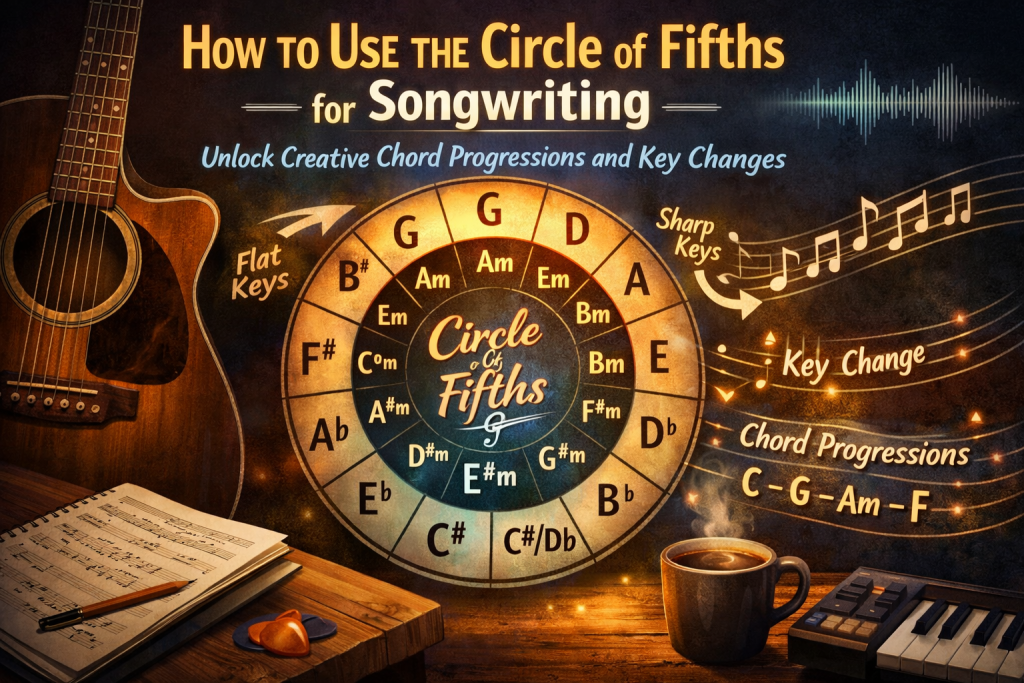
At its core, the Circle of Fifths is a visual representation of the 12 keys in Western music. Each key is arranged in a circle based on the interval of a perfect fifth.
- Clockwise movement: Each step represents a perfect fifth (C → G → D → A → E…).
- Counterclockwise movement: Each step represents a perfect fourth (C → F → B♭ → E♭…).
- Relative minors: Each major key has a corresponding relative minor, found three steps clockwise (e.g., C major → A minor).
This layout helps you quickly identify which keys and chords naturally relate to one another.
2. Crafting Chord Progressions Using the Circle of Fifths
One of the most powerful uses of the Circle of Fifths is building chord progressions. Chords that sit next to each other on the circle tend to sound smooth and natural together.
How to use it:
- Start with a key: For example, C major includes C (I), F (IV), G (V), and A minor (vi).
- Use adjacent chords: Chords next to your tonic create smooth progressions. In C major, F and G sit beside C, forming the classic I–IV–V progression.
- Experiment with movement: Moving in fifths (C → G → D → A) creates strong forward momentum and a sense of harmonic direction.
The circle gives you a quick way to find progressions that feel intuitive and musical.
3. Modulating Between Keys Using the Circle of Fifths
The Circle of Fifths is also a powerful tool for modulation — shifting from one key to another. It helps you choose key changes that feel smooth or dramatic, depending on your creative goals.
How to use it:
- Subtle modulations: Move to a key next to your current one (C → G or C → F). These keys share many notes, making transitions seamless.
- Emotional shifts: Move from a major key to its relative minor (C major → A minor) for a gentle mood change.
- Dramatic modulations: Jump to a distant key (C major → A major or E major) for bold, surprising transitions.
The circle visually shows how far apart keys are, helping you choose the right level of contrast.
4. Incorporating Secondary Dominants for a Fresh Sound
Secondary dominants add color and tension to your progressions by temporarily emphasizing a chord other than the tonic.
How to use it:
- Find the dominant of your target chord: In C major, to strengthen the pull toward G (V), use D (the V of G) first: C → D → G
- Explore additional secondary dominants: The Circle of Fifths helps you quickly identify dominant relationships for other chords in your progression.
Secondary dominants create movement and richness without fully changing keys.
5. Creative Chord Substitutions Using the Circle of Fifths
Chord substitutions can give your progressions a fresh twist. The Circle of Fifths helps you identify chords that can be swapped for others while maintaining musical coherence.
How to use it:
- Substitute chords in similar positions: Chords that share a relative position on the circle often work as substitutes. Example: In C major, swap G major (V) for E minor (iii) for a softer sound.
- Use borrowed chords: Borrow chords from the parallel minor (e.g., A♭ major in C major) to add unexpected color. The circle helps you see which chords belong to nearby keys.
Substitutions add variety without losing the listener.
6. Incorporating Diminished Chords for Tension
Diminished chords create tension and help lead the listener toward resolution. The Circle of Fifths helps you understand where these chords naturally fit.
How to use it:
- Use diminished chords as passing chords: In C major, B diminished leads smoothly to C.
- Add tension before resolving: Diminished chords heighten suspense before landing on a stable chord.
These chords add drama and emotional intensity to your progressions.
Final Thoughts
The Circle of Fifths is a powerful tool that can inspire new ideas and bring creativity to your songwriting process. Whether you’re crafting smooth chord progressions, exploring key changes, or adding harmonic complexity, the Circle of Fifths gives you a clear map of how keys and chords relate.
By understanding these relationships, you’ll unlock a world of creative possibilities that elevate your songwriting and help your music stand out.